

Table Games
Trips Bet Pay Table in Ultimate Texas Hold'em
If you’ve played Ultimate Texas Hold’em, you know the table dynamic is unlike any other casino game. You play your two hole cards against the dealer, share the community board, and at some point before the deal you have to decide whether to place the Trips bet. For many players, that extra circle on the felt is a mystery: when does it pay, how much does it pay, and is it worth including in your strategy?
This guide focuses specifically on that side bet. We won’t walk through the full game mechanics from scratch — instead, we’ll clearly explain what the Trips pay table is, how to read it, what factors make it vary between casinos, and what you should keep in mind before sitting down at any UTH table in Bogotá or any other casino.
One word of caution before we go further: Trips pay tables are not universal. Different casinos — and sometimes different tables within the same casino — may use different versions. That’s why, at the end of this analysis, we’ll tell you where to check the exact table currently in effect at The Lounge.
What exactly is the Trips bet and why does it exist
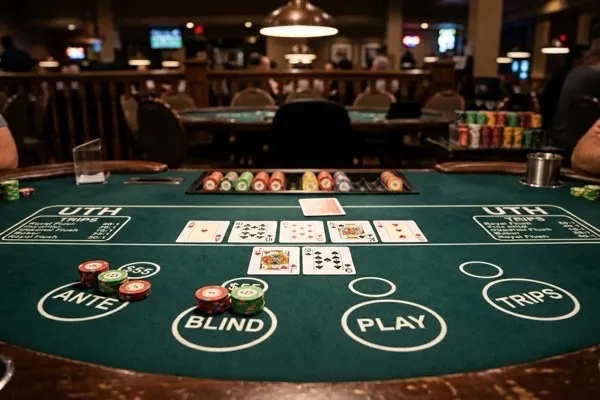
Ultimate Texas Hold’em has three betting positions on the felt: Ante, Blind, and Play. Trips is a fourth position, separate from the other three, that functions as an independent side bet. The reason it exists is straightforward: the main game bet depends on whether you beat the dealer, but Trips does not. Its only criterion is the quality of your final hand.
This means that if you end up with a full house but the dealer has a better hand, you lose Ante, Blind, and Play — but Trips still pays you. Conversely, if you win the main hand with a pair of aces, Trips pays nothing because a pair doesn’t reach the table’s minimum threshold. The two bets run on parallel tracks and their outcomes are evaluated separately at the end of each hand.
From the casino’s perspective, side bets like Trips exist because they carry a different house edge than the main bet, and because they give players an additional reason to root for a favorable board even when the main hand is already lost. From the player’s perspective, Trips adds volatility: you can have sessions where the side bet offsets losses on the main hand, and sessions where you consistently lose both.
How a Trips pay table is structured
A Trips pay table lists poker hand categories from highest to lowest and assigns each one a multiplier on the original bet. The general structure looks like this:
| Hand | Poker rank |
|---|---|
| Royal Flush | Highest payout on the table |
| Straight Flush | Second highest |
| Four of a Kind | Third tier |
| Full House | Fourth tier |
| Flush | Fifth tier |
| Straight | Sixth tier |
| Three of a Kind | Minimum hand that activates the bet |
| Two pair or lower | Does not pay |
The specific multipliers assigned to each hand are what vary between casinos and between table versions. There are at least two or three variants widely used in the industry, and the difference between them can be significant over the long run. That’s why the table at the felt is the only document that matters — not the one you found on a forum, not the one from another casino, but the one published at the table where you’re going to play.
Why multipliers vary and what that means for players
When a casino chooses a Trips table variant, it is adjusting the house edge on that side bet. A table that pays more on frequent hands (like full house or flush) and less on rare hands (like a Royal Flush) has a different risk profile than a table that concentrates high payouts on premium hands.
For players, this has two practical consequences. The first is long-term: the expected return (RTP) of the Trips bet depends directly on which table the game uses. The second is session experience: a table that pays well on frequent hands produces more small and medium wins throughout the night, while a table focused on premium hands may go many hands without paying and then deliver a large payout when a four of a kind or straight flush appears.
Neither is objectively better for all players. It depends on your tolerance for variance and how long you plan to be at the table. What is objectively better for everyone is knowing the table before betting, not after.
Trips independence from the main hand: concrete examples
It’s worth dwelling on this point because it frequently causes confusion. When we say Trips is independent, it’s not just a phrase — it’s a rule that changes how you evaluate every hand.
Say you hold A-K in your hole cards, and the community board shows A-A-7-2-J. Your best five-card hand is three aces. The dealer shows Q-Q-Q-9-7, three queens. The dealer wins the main hand because their three of a kind outranks yours. You lose Ante, Blind, and Play. But Trips evaluates only your hand, which is three aces. If that hand qualifies on the table, Trips pays.
The reverse also happens: you hold 6-8, the board shows K-Q-J-9-7. Your best hand is a straight, which is a relatively strong hand. The dealer has K-K-K-Q-Q, a full house. The dealer wins the main hand. But your straight qualifies on the Trips table, so that side bet pays even though you lost everything else.
This independence is what gives Trips its own internal logic. It’s not insurance on the main hand or a complement to it — it’s a separate bet that simply shares the same card deal.
Basic strategy around the Trips bet
Talking about strategy for a side bet has a clear limit: there are no decisions to make during the hand. Trips is placed before the deal and cannot be changed. So the only real strategic decision is whether to include it at all, and at what amount.
Some players set a Trips amount equal to their Ante and keep it constant throughout the session. Others vary the amount based on mood or the pace of the session, which has no mathematical effect on the expected outcome since each hand is independent. Some players simply don’t play it, and that’s also a perfectly valid choice.
What does make sense to check before deciding is the house edge of the table variant the casino uses. If the table in play has a reasonable expected return for a side bet, including it consistently at moderate amounts is a way to add controlled variance to your session. If you prefer to minimize the house edge at all times, the main UTH bet already has its own risk profile and you can skip Trips without any issue.
Where to play UTH in Bogotá and what to verify before betting
The Lounge, located in Zona T (Calle 81 #12-70), offers Ultimate Texas Hold’em tables as part of its table games lineup. Before sitting down, the recommended procedure is always the same: check the felt, look for the pay table card that should be visible at the table, and confirm that the Trips table you see matches what was published on the site.
If there’s any discrepancy, or if the table isn’t clear, it’s completely normal to ask the dealer before placing chips. UTH dealers are used to that question and should be able to show you the current table. There’s no reason to bet on a table you don’t understand or haven’t been able to verify.
You can also browse the rest of the casino offering to compare what other table games are available on the same visit. If UTH isn’t your only game of the night, it may make sense to split your time across several tables. Blackjack and Punto y Banca have their own dynamics and their own side bets, each with rules worth reviewing on their respective pages before playing.
Finally, if you play at The Lounge regularly, the N1VEL Club accumulates benefits based on time played at tables and machines. The current thresholds and conditions are published on that page, and it’s worth checking them if you plan to visit the casino more than once.
Related references
Frequently Asked Questions
- Is the Trips bet mandatory in Ultimate Texas Hold'em?
- No. The Trips bet is optional. You can play with just Ante and Blind. Check the exact table conditions on the casino's Ultimate Texas Hold'em page.
- Does the Trips bet pay even if I lose the main hand?
- Yes. Trips is independent of the outcome against the dealer. If your best five-card hand is three of a kind or better, the Trips bet pays according to the table in effect at that table, even if you lost your Ante and Blind.
- Where can I see the exact pay table The Lounge uses?
- The current pay table is published on the casino's Ultimate Texas Hold'em page. Casinos may use different variants of the table, so it's worth verifying it before you play.
- What is the minimum hand that triggers a Trips payout?
- In most UTH variants, the minimum hand that triggers Trips is three of a kind. However, the exact table can vary by casino and table. Verify the current table before betting.
- Can I change my Trips bet during the hand?
- No. The Trips bet is placed before the deal and cannot be changed once the dealer has dealt the cards.
El juego descontrolado genera adicción. Juegue con moderación. Solo mayores de 18 años. Línea de ayuda: 106 (Secretaría de Salud de Bogotá).