

Table Games
European vs American roulette: which has better odds and why it matters
When you sit down at a roulette table, the most important question is not which number you are going to bet on. It is which version of the game you are playing. The difference between European and American roulette looks small at first glance, but it has a direct, measurable effect on your odds of winning — and on how much you can expect to lose on every bet you make.
This article explains that difference clearly and without detours. If you already know roulette, you will find the mathematical logic behind something you may have sensed all along. If you are new to the game, this is the best starting point before you place a single chip on the felt.
The difference that changes everything: one number on the wheel
A European roulette wheel has 37 slots: the numbers 1 through 36 and a single zero (0). An American roulette wheel has 38 slots: the same 36 numbers, the zero (0), and an additional double zero (00).
That double zero is the source of everything. When you bet on a straight number in European roulette, you have a 1-in-37 chance of winning. The payout is 35 to 1, the same in both versions. The casino keeps the difference: one slot out of 37 that does not pay. That represents a house edge of approximately 2.7%.
In American roulette, you are betting 1 against 38, but the payout is still 35 to 1. Now there are two slots the casino keeps without paying. The edge rises to approximately 5.26% — nearly double.
This logic applies equally to every bet on the table, whether you bet on red or black, dozens, columns, or any inside combination. The house edge percentage is constant within each variant.
Comparison table: the key differences
| Feature | European roulette | American roulette |
|---|---|---|
| Slots on the wheel | 37 | 38 |
| Zeros | Only the 0 | The 0 and the 00 |
| House edge (approx.) | 2.7% | 5.26% |
| Five Numbers bet (0, 00, 1, 2, 3) | Does not exist | Available (even higher edge) |
| En prison / la partage rule | On some tables | Generally not available |
| Historical origin | Europe, 18th century | Adaptation for US casinos |
The Five Numbers bet deserves a special mention. It is exclusive to American roulette and covers 0, 00, 1, 2, and 3. Its house edge is even higher than the American table average, making it the worst bet available in any standard version of roulette.
When it makes sense to play European roulette
The mathematical answer is straightforward: if you have access to both versions, European is the rational choice. The house edge is lower, which means that, on average, your chips last longer and your bankroll erodes more slowly.
This matters especially if you plan to play for several hours or if you are making significant bets. In the short term, luck can produce any outcome, but as you accumulate more rounds, the house edge becomes increasingly visible in your results.
If the European table also offers the en prison or la partage rules, the house edge on even-money bets (red/black, odd/even, high/low) can drop to around 1.35%. Under those rules, when zero lands, you either get half your bet back or leave it “in prison” for the next spin. Not every table offers them, so it is worth asking before you sit down.
When American roulette might still make sense
Honesty requires saying that, in purely mathematical terms, American roulette holds no advantage over European roulette for the player. The house edge is always higher.
That said, there are situations where a player may end up at an American table without it being a serious mistake. If it is the only option available at that moment, if the minimum bet is significantly lower than at the European table, or if you simply want to try the variant, playing with awareness is what makes the difference.
What is worth avoiding in American roulette is the Five Numbers bet already mentioned. There is no mathematical reason to make it when other options are available at the same table.
What both versions share
Beyond the number of zeros, both roulettes operate on the same core mechanics. The dealer spins the ball in the opposite direction to the wheel’s rotation, and the outcome is independent of any previous round. The roulette wheel has no memory.
This point matters because one of the most common ideas among players is the notion of a “hot number,” or the belief that if red has come up seven times in a row, black is “due.” That is not how it works. Each spin is an independent event, and the probability of red or black does not change based on the table’s history.
Progressive betting systems such as the Martingale — which involves doubling your bet after every loss — also do not change the house edge. They alter the distribution of your results in the short term, but not the percentage the casino expects to earn on total bets placed.
How to explore table games at The Lounge
If you are in Bogotá and want to put what you have learned here into practice, Zona T is a great starting point. The Lounge Casino, located on Calle 81 at carrera 12, offers a table game selection that goes well beyond roulette.
If roulette feels too luck-dependent and you prefer a game where decisions carry more weight, it is worth checking out Blackjack or Blackjack Loco, where basic strategy significantly reduces the house edge. For those who prefer a more relaxed pace with straightforward bets, Punto y Banca is another option with its own probability logic.
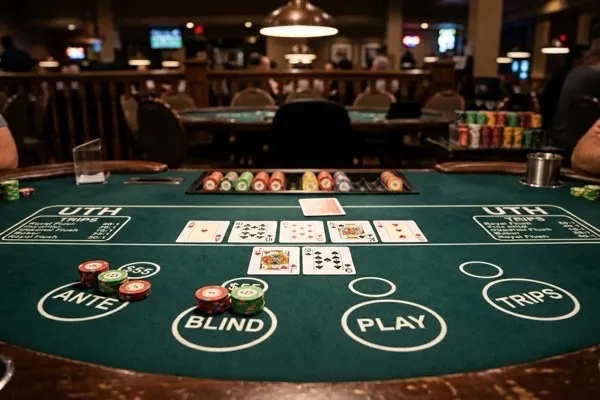
There is also Ultimate Texas Hold’em, which combines poker structure with the dynamic of playing against the house, and the poker room, where your opponents are the other players at the table rather than the casino.
The variety of games available at the casino lets you compare options and choose the one that best fits your playing style and risk tolerance. If you play with some regularity, the Club N1VEL loyalty program accumulates benefits based on your activity. And if you want to see what is on offer before you visit, the promotions section shows current deals.
The most important thing, however, is not which table you choose but the mindset you bring to it. Knowing the difference between European and American roulette, understanding where the house edge comes from, and deciding how much you are willing to bet before you start — these three things are what separate an informed player from one who simply leaves everything to chance.
Frequently Asked Questions
- Does European roulette always have better odds than American roulette?
- Mathematically, yes. The house edge in European roulette is roughly half that of American roulette, because it has a single zero instead of two. That translates into lower expected losses per bet over the long run.
- Do inside and outside bets have different odds in roulette?
- The house edge is the same for every bet at a given table, whether you are betting on straight numbers, columns, or red/black. What changes is how often you win and how much you receive when you do — not the percentage that favors the casino.
- Is there any strategy that eliminates the house edge in roulette?
- No. No betting system — Martingale, Fibonacci, D'Alembert, or any other — changes the mathematical house edge. These systems affect the distribution of your wins and losses in the short term, but they do not change the expected outcome over the long run.
- Does The Lounge Casino in Bogotá have roulette?
- To find out which roulette tables are currently available, the best approach is to check the casino section of the site directly or contact the casino, as the availability of game variants can change.
El juego descontrolado genera adicción. Juegue con moderación. Solo mayores de 18 años. Línea de ayuda: 106 (Secretaría de Salud de Bogotá).