

Table Games
Basic strategy for Ultimate Texas Hold'em: how to make better decisions at the table
Ultimate Texas Hold’em is one of those games that draws in both poker players and people who have never touched a Texas Hold’em deck. The promise is straightforward: you use the same cards you know from poker, but you play against the house instead of against other players. There is no need to read tells or manage a table full of rivals. It is just you, the dealer, and the decisions you make at three key moments.
The problem is that many players sit down without understanding the structure of the game and end up making decisions on instinct. Betting big when they should wait, or checking when they had a hand that deserved pressure. Basic strategy for Ultimate Texas Hold’em does not require card counting or memorizing complex charts. It requires understanding when the value of your hand justifies committing chips and when it does not.
This guide is designed to help you arrive at the table with a clear framework. Not so you always win — no strategy achieves that — but so you make informed decisions and reduce the house edge as much as the game allows.
The structure of the game before we talk strategy
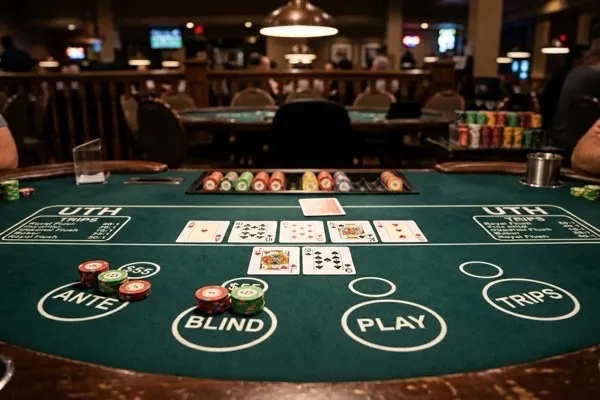
Before discussing what to do with each hand, you need a clear picture of how the game is built. In Ultimate Texas Hold’em you must place two equal bets at the start: Ante and Blind. You then receive two private cards and the dealer receives theirs. From that point the game moves through three decision points: preflop, flop, and turn/river.
At each of those points you can make a Play bet or check. The Play bet carries a multiplier that varies depending on the moment: it is higher if you bet early and lower if you wait. If you reach the turn/river without having bet, you are forced to either bet or fold, losing your Ante and Blind. This mechanic is central to strategy: betting early with a strong hand captures a higher multiplier, but it also exposes more chips before the community cards have appeared.
For the exact details on multipliers, the conditions under which the dealer qualifies, and the Blind pay table, check the Ultimate Texas Hold’em page. Rules can vary between tables, and the version offered in Colombia does not always replicate international versions.
When to bet big preflop
The preflop is the highest-value moment because the Play multiplier is at its peak. The logic of basic strategy here is to bet big when your two-card hand has enough expected value to justify that commitment before seeing the community cards.
Hands that generally warrant a big preflop bet are high pairs, aces with a high kicker, and high suited connectors. With a pair of aces or kings in hand, the value is solid enough that waiting makes little sense. With a hand like 7-2 offsuit, waiting for the flop is the more reasonable decision because the extra multiplier does not compensate for the weakness of the hand.
The line between “bet now” and “wait” is not always obvious with middle-ground hands. An ace with a low kicker, for example, has value but also vulnerability. In those cases, basic strategy tends to recommend waiting for the flop to make a decision with more information. The key is not to bet big simply out of impatience or a desire to “commit” to the hand.
What to do on the flop: reading the three community cards
When the three flop cards appear, you already have five of the seven cards that will form your final hand. At this point, if you did not bet preflop, you can bet at an intermediate multiplier or continue waiting for the turn/river at a lower multiplier. If you already bet preflop, you simply observe the flop with no additional action.
Flop strategy revolves around the strength of your current hand and its potential to improve. If you connected well with the flop — you have a high pair, two pair, or better — betting makes sense because your hand is already competitive. If you have a strong draw such as a four-card straight or a flush draw with high cards, the decision depends on whether the potential justifies the multiplier available at this point.
What you should avoid on the flop is betting with weak hands in the hope that the turn or river will rescue a compromised situation. Ultimate Texas Hold’em does not reward groundless optimism. If the flop did not help you and your starting hand was marginal, waiting for the turn/river at the lower multiplier is usually the least costly option.
The turn and river decision: the moment not to fold without reason
When you reach the turn/river without having bet, you are at the lowest multiplier point. Here the decision simplifies: bet or fold. Folding means losing your Ante and Blind without seeing the outcome, which is a fixed cost. Betting at the low multiplier means committing additional chips but staying in the hand.
Basic strategy at this point is almost always to bet rather than fold, unless your hand is so weak that the odds of winning are very low. With any pair, a strong draw, or a hand with reasonable potential, betting is preferable to surrendering your Ante and Blind without a fight. Folding only makes sense when the hand is genuinely worthless and the community cards offer no way out.
This is a frequent mistake among new players: folding on the turn/river out of fear of losing more, when in reality they are guaranteeing a larger loss by giving up Ante and Blind with no chance of recovery. The math of the game favors staying in the hand in most scenarios at the low multiplier.
The Trips bet: when it makes sense and when it does not
Trips is the side bet in Ultimate Texas Hold’em. Unlike the main bets, Trips pays based on the absolute value of your hand and does not depend on whether the dealer qualifies or whether you win the main hand. If you have a full house, a straight flush, or an equivalent hand, Trips pays regardless of the result against the dealer.
The appeal of Trips is that it allows for big payouts with strong hands without the main hand result affecting the payout. That makes it attractive for players chasing the excitement of a large win. However, Trips carries its own house edge and is not a neutral bet. The exact pay table is posted at the table when you sit down, and values can vary.
From a basic strategy standpoint, the recommendation is to treat Trips as a separate bet with its own analysis. If you decide to make it, set a clear limit before you sit down. Do not use it as a mechanism to “recover” losses from the main bets, because they are independent bets with different dynamics.
Common mistakes that basic strategy helps you avoid
The first and most frequent is betting big preflop with mediocre hands out of enthusiasm. Seeing an ace with a low kicker and betting the maximum because “I have an ace” is a mistake that basic strategy corrects quickly. The ace only has real value when the kicker supports it or when the flop strengthens it.
The second mistake is folding too early. As mentioned above, many players fold on the turn/river when they should bet the minimum and see the outcome. The cost of folding at that point is usually greater than the cost of betting with a weak hand and losing the main hand.
The third is ignoring the dealer qualifying structure. If the dealer does not qualify, the Ante and Blind bets behave in a specific way according to the table rules. Playing without understanding that mechanic can lead to misreading results and making poor decisions on subsequent hands. Before sitting at any table — whether at The Lounge in Zona T or at any other casino — it is worth reading the rules of that specific table.
Basic strategy is not a magic formula. It is a set of decisions that, applied consistently, reduce the house edge to its lowest mathematically possible level. The game is still one of chance and there will be sessions where the cards simply do not cooperate. But the difference between playing with a clear framework and playing on instinct accumulates over time.
If you want to explore other table games with similar strategic decisions, Blackjack and Blackjack Loco offer structures where basic strategy also has a measurable impact. For a different pace and no player decisions, Punto y Banca is an alternative that many players alternate with Texas Hold’em.
Related references
Frequently Asked Questions
- Is it possible to beat the house in Ultimate Texas Hold'em with basic strategy?
- Basic strategy reduces the house edge but does not eliminate it. With optimal decisions you can minimize expected losses over the long run, but the game is still one of chance. No strategy guarantees winnings.
- When is it worth betting preflop in Ultimate Texas Hold'em?
- The general rule is to bet big (4x) with premium hands: high pairs, aces with a high kicker, and high suited connectors. With marginal hands it is better to wait for the flop or the turn/river before deciding. Check the Ultimate Texas Hold'em page for the exact table rules.
- What happens if the dealer does not qualify in Ultimate Texas Hold'em?
- When the dealer does not qualify, Ante and Blind bets are generally paid or returned according to the table rules. The Play bet always pays 1:1 if you win the hand. Check the current rules at /en/casino/ultimate-texas-holdem for exact details.
- Is the Trips bet worth making?
- Trips is an independent side bet that pays based on the absolute value of your hand, regardless of whether the dealer qualifies. It can be attractive if you are chasing big payouts with hands like royal flushes or full houses, but it carries its own house edge. The exact pay table is posted at the table.
- Can I practice Ultimate Texas Hold'em before playing with real money?
- The best preparation is to get familiar with the betting structure and key decision points before you sit down. Reading the rules at /en/casino/ultimate-texas-holdem and understanding the logic behind each decision will serve you better than any generic simulator, since rules can vary by table.
- Is the Ultimate Texas Hold'em played in Colombia the same as the version in Las Vegas?
- Not necessarily. Rules can vary: the Blind pay table, the conditions under which the dealer qualifies, and the available side bets may all differ. Always check the rules of the specific table where you are going to play.
El juego descontrolado genera adicción. Juegue con moderación. Solo mayores de 18 años. Línea de ayuda: 106 (Secretaría de Salud de Bogotá).