

Poker Room
Texas Hold'em vs Omaha 5 Cards: Key Differences to Choose Your Game
If you have been playing poker for a while, at some point someone has probably told you to try Omaha. And if you come from the other direction, you have likely been warned that Texas Hold’em is “easier to learn but harder to master.” Both phrases hold some truth, but neither tells you enough to make an informed decision about which variant to play, when, and with what preparation.
This article compares Texas Hold’em and Omaha 5 Cards directly: hand structure, betting dynamics, strategic complexity, and the type of player who tends to thrive in each. The goal is not to declare one better than the other, but to understand which fits your style and where you are as a player.
The basic rules: what changes from the very first hand
In Texas Hold’em each player receives two private cards. You combine those two cards with the five community cards on the board however you like, using zero, one, or both of your hole cards. The freedom is total.
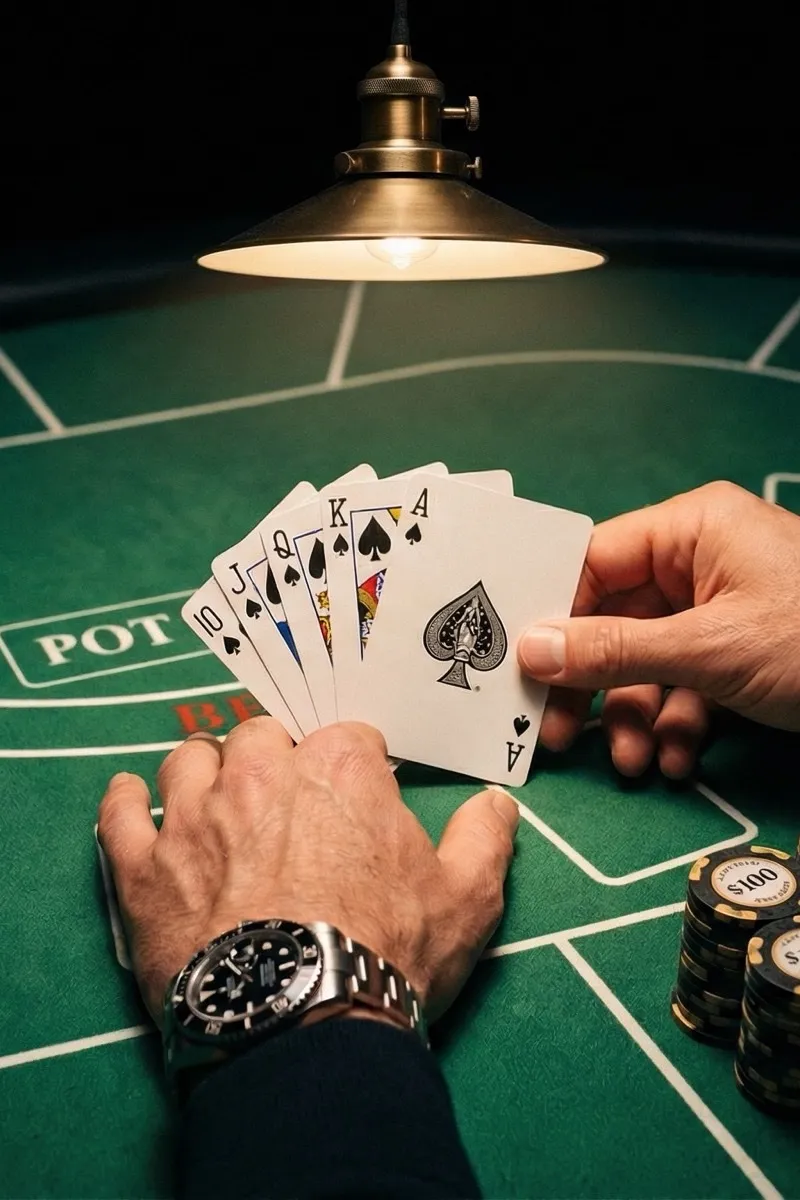
In Omaha 5 Cards the situation is different from the deal: you receive five private cards. But here comes the restriction many players underestimate: you must use exactly two of your five hole cards and exactly three of the five community cards. No more, no less. This is not optional or a table convention; it is the rule that defines the game. The practical result is that your five hole cards give you more possible combinations, but the requirement to use exactly two of them radically changes how you read your own hand and your opponents’.
An example that makes this clear: if the board shows four hearts and you have one heart in your hand alongside four cards of other suits, in Omaha you do not have a flush. To have one you would need two hearts in your hand. In Hold’em, a single heart would complete the flush. This difference seems small on paper, but at the table it produces costly mistakes with surprising frequency.
The betting structure: why Omaha is almost always Pot Limit
Texas Hold’em is played predominantly in No Limit format: you can bet your entire stack at any moment. That creates dramatic all-in situations and is part of what made the variant famous in televised tournaments and on the world circuit.
Omaha, by contrast, is played almost universally in Pot Limit. The maximum bet at any point equals the current size of the pot. This is not arbitrary: with five hole cards, the equities between competing hands are much closer than in Hold’em. Allowing unlimited bets in that context would create an unbalanced dynamic where pure bluffing loses almost all its strategic value. Pot Limit keeps the action controlled without eliminating pressure.
The consequence for the player is that in Omaha pots grow more organically across betting streets. It is less common for a single bet to close the hand before the river; players reach showdown more often, and that increases the overall variance of the session.
When it makes sense to play Texas Hold’em
Texas Hold’em is the natural entry point to poker for a concrete reason: with only two hole cards, the number of possible combinations is manageable. Learning to read the board, estimate basic equities, and build a reasonable opening hand range takes time, but the initial curve is less steep than in Omaha.
If you are just starting out or have been playing regularly for only a short time, Hold’em lets you focus on the fundamentals that apply to any variant: table position, reading your opponents’ tendencies, managing bet sizing, and discipline in hand selection. Mastering those concepts in Hold’em will give you a solid foundation before moving to more complex formats.
Hold’em is also the dominant variant in tournaments. If your goal is to compete, whether in local circuits or larger events, most of the tournament schedules you encounter will be structured around No Limit Texas Hold’em. You can check the current schedule on the Tournaments page to see which formats are coming up.
When it makes sense to play Omaha 5 Cards
Omaha attracts players who want more action per hand and who enjoy combinatorial complexity. With five hole cards, the chances of connecting with the board are greater, pots tend to be more contested, and decisions on each street require more detailed analysis.
That comes at a cost: variance is higher. In Hold’em it is possible for a premium hand like pocket aces to dominate its opponent by a wide margin before the flop. In Omaha that margin shrinks considerably because your opponent has five cards to build their hand. River surprises are more frequent, which means bankroll management becomes more important, not less.
Omaha also rewards players who have clarity about what constitutes a strong hand in that variant. Players arriving from Hold’em sometimes overvalue hands that look strong but are vulnerable in Omaha. A low straight or a flush with a weak kicker can be expensive in a large pot.
What both variants have in common
Beyond their differences, Hold’em and Omaha share the same hand structure: preflop, flop, turn, and river, with a betting round on each street. The five community cards are the same for every player at the table, and the objective is to build the best five-card hand according to the standard poker hand rankings.
That means the strategic fundamentals transfer between variants. Table position remains one of the most decisive factors. Acting after your opponents gives you information they do not have when it is their turn to decide. Opening hand selection still matters, although the range of playable hands differs between variants. And reading your opponents’ behavior — their betting patterns, decision timing, and tendencies throughout the session — applies in any format.
The General Rulebook for the room covers the rules that apply to all tables regardless of variant. It is worth reading before you sit down for the first time, or if you have been playing for a while and want to verify a specific point.
How to try both variants in the same night
The Poker Room at The Lounge, located in Zona T in Bogotá on Calle 81, runs cash game tables with different variants depending on player demand each session. If you want to explore Omaha for the first time, a practical approach is to arrive early, start at a Hold’em table to warm up, and ask the room staff whether Omaha tables are available or forming.
The room also has specific rules about moving between tables. If you are at a table that is emptying out or filling up, the Must Move system may affect your seat. Understanding how that mechanism works before it happens to you is more comfortable than discovering it mid-session.
Another element worth knowing before you play is the Bad Beat Jackpot. The exact conditions — including which variants qualify and what the hand requirements are — are published on that page. Do not assume that what applies in one variant automatically applies in the other.
If you play with some regularity, the N1VEL Club accumulates benefits over time. The current thresholds and conditions are on that page, as these details are updated periodically. And if you have questions about logistics, reservations, or table availability, the Contact and Reservations page is the most direct channel.
Frequently Asked Questions
- Can I play Omaha 5 Cards if I only know Texas Hold'em?
- Yes, but you need to watch out for a very common mistake: in Omaha you are required to use exactly two of your hole cards and three from the board. Many players coming from Hold'em forget this rule and overestimate their hand. Before sitting down at an Omaha table, review the full rulebook at /en/poker/rules.
- Which of the two games has larger pots on average?
- Omaha, by its structure, tends to generate larger pots because players reach the river with stronger hands and greater shared equity among several contenders. That does not mean it is more profitable for the player; there is simply more action and more variance.
- Which variant is played in The Lounge Casino tournaments?
- The tournament schedule includes different formats. Check the current tournaments on the Tournaments page of the site to see which variants are scheduled.
- Does the Bad Beat Jackpot apply at Omaha tables?
- The exact conditions of the Bad Beat Jackpot, including which variants qualify and what the hand thresholds are, are published on the Bad Beat Jackpot page. Check them before assuming a hand qualifies.
El juego descontrolado genera adicción. Juegue con moderación. Solo mayores de 18 años. Línea de ayuda: 106 (Secretaría de Salud de Bogotá).