

Poker Room
Omaha Poker: a complete guide to understanding and playing this variant
If you have been playing Texas Hold’em for a while and feel you have a solid grasp of its rhythms, Omaha poker tends to be the natural next step. Not because it is easier, but because it forces you to think differently. Hands are built differently, boards are read differently, and mistakes that seemed minor in Hold’em get punished fast here.
This guide is written for someone who already knows the basics of poker and wants to genuinely understand Omaha: its rules, its variants, the logic behind the strategy, and how it differs from the Hold’em you already know. It is not a tricks manual or a list of magic tips. It is an honest explanation of a game that has far more depth than it appears to at first glance.
If after reading you want to try it live, the Poker Room at The Lounge, in Bogotá’s Zona T, is a great place to start.
The rule that changes everything: two of four, always
The most important difference between Omaha and Texas Hold’em is not the number of cards you receive. It is the obligation to use them in a specific way.
In Hold’em you can use zero, one, or two of your hole cards alongside the community cards. In Omaha you do not have that freedom: you must use exactly two of your four hole cards and exactly three of the five community cards. Always. No exceptions.
That rule sounds simple but has enormous consequences. Imagine the board shows four hearts and you hold the ace of hearts. In Hold’em you would have a flush. In Omaha, you do not: you need two hole cards of hearts to make a flush. If you only have one, it does not count. This is the most common mistake among players who come from Hold’em and start playing Omaha without having fully internalized the rule. Reading the board in Omaha requires a different level of attention because you must always verify that your hand is built with exactly two of your own cards.
Main variants: PLO, Hi/Lo, and Fixed Limit
Omaha poker is not a single game. There are several versions that share the same base structure but differ in how bets are made or how the pot is won.
Pot Limit Omaha (PLO) is the most widely spread variant in card rooms around the world. The maximum bet on each street equals the current size of the pot. That means pots grow quickly because each large bet expands the pot for the next player. PLO generates constant action and substantial pots, making it attractive to both recreational players and regulars. If someone tells you they play Omaha without specifying a variant, they almost always mean PLO.
Omaha Hi/Lo (also called Omaha 8-or-Better) splits the pot between two winners: the player with the best high hand and the player with the best qualifying low hand. For a low hand to count, it must be made up of five different cards with a value of eight or lower, with no pairs. If nobody at the table has a valid low hand, the winner of the high hand takes the entire pot. This variant adds an important strategic layer because you can aim to win both sides of the pot at the same time — a move known as scooping.
Fixed Limit Omaha is the version with fixed bet sizes per street. Bets preflop and on the flop are a set size; on the turn and river that size doubles. It is a more controlled variant in terms of variance, though not necessarily simpler when it comes to decision-making.
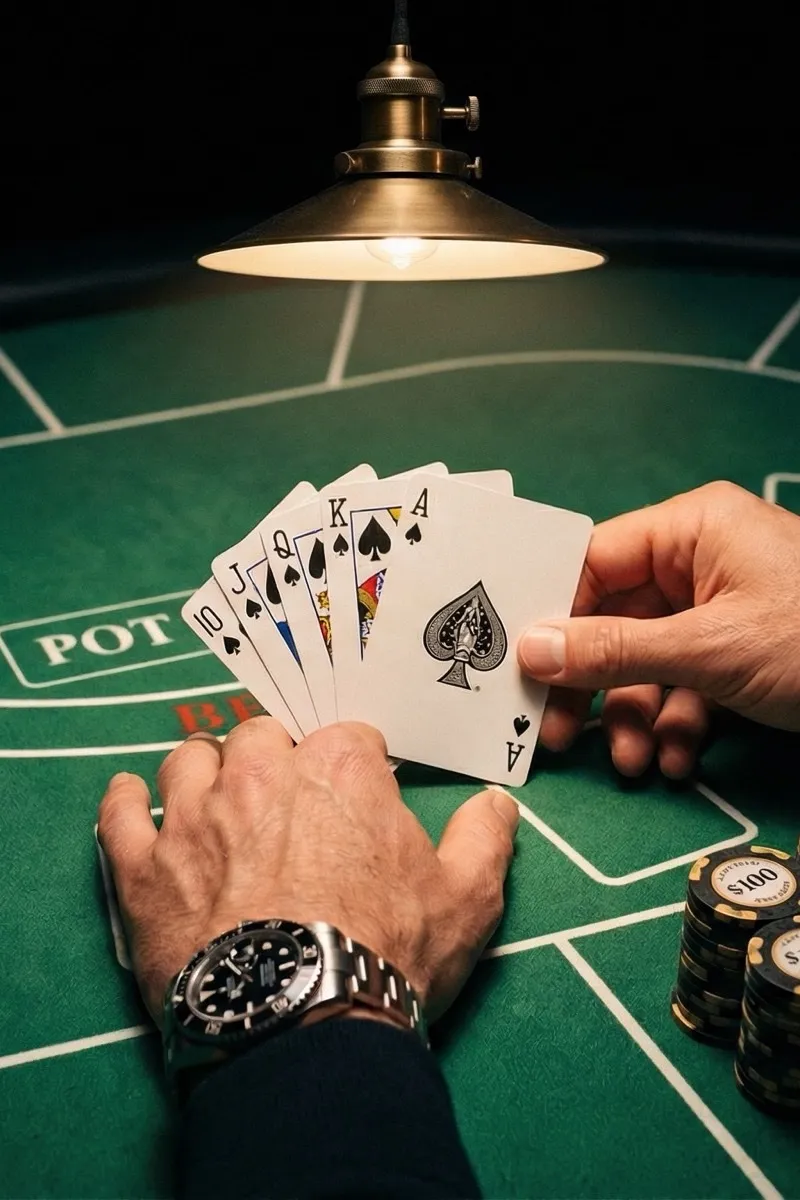
How an Omaha hand plays out
The hand structure follows the same framework as Hold’em: there is a small blind and a big blind, cards are dealt, and then four betting streets follow: preflop, flop, turn, and river.
The dealer deals four cards face down to each player. The preflop betting round begins with the player to the left of the big blind. Then three community cards are revealed on the flop, followed by a betting round. The fourth community card (the turn) comes next, then another betting round, and finally the fifth community card (the river) with the last round of betting. If more than one player reaches showdown, cards are revealed and the winner is determined by applying the two-of-four rule.
One important practical difference: in Omaha, strong hands are far more common than in Hold’em because each player has four cards to work with. That means showdowns are typically won by very strong hands — straights, flushes, and full houses appear with much greater frequency. If a high pair can sometimes be enough to win in Hold’em, in Omaha that hand rarely holds up to the end. The baseline strength of winning hands is considerably higher.
Basic strategy: how to think in Omaha
The first strategic adjustment is understanding the value of your four hole cards based on how well they work together. In Omaha, the best starting hands are those where all four cards pull in the same direction: they have connectivity (cards close in rank), double suitedness (two pairs of cards sharing a suit), and potential to form both straights and flushes. A hand like A-A-K-Q double suited is far stronger than A-A-7-2 of mixed suits, even though both contain a pair of aces.
The second adjustment involves the concept of the nut hand. In Omaha, especially in PLO, strategy revolves heavily around holding or drawing to the best possible hand on any given board. Betting aggressively with a hand that is not the nuts on that board is one of the most common sources of loss for players coming from Hold’em. The question you should constantly be asking yourself is: what is the best possible hand on this board, and do I have it or something close to it?
The third point is pot management in PLO. Because bets grow with the size of the pot, a sequence of bets can escalate very quickly. Knowing when you have enough equity to continue and when you do not is a skill that develops with time and experience. There are no shortcuts here: real table practice is irreplaceable.
Live Omaha: what changes compared to playing online
Playing Omaha in a physical card room has dynamics that the online environment does not replicate. Hands move more slowly, which gives you more time to think, but it also demands that you manage the visual information around you: other players’ posture, their betting patterns, the pace at which they look at their cards.
At a live Omaha table, handling four hole cards also takes physical practice. Reading four cards at a glance without accidentally exposing them, remembering them accurately as the board develops, and quickly calculating which combinations are possible are all skills sharpened through repetition.
The Lounge, at Calle 81 #12-70, has one of Bogotá’s most active poker rooms, with tables catering to different experience levels. If you want to find out which variants are available at any given time, the best approach is to check the Poker Room page or write directly through the Contact and Reservations page. Active tables depend on demand and the schedule, so it is worth checking before you head over.
It is also useful to know the room’s rules before you sit down. The General Poker Rules cover standard table procedures, and if the room has active jackpots, the conditions for the Bad Beat Jackpot are published on their own page. Knowing those rules in advance avoids surprises.
Omaha tournaments and how to find them in Bogotá
Tournament Omaha has a different dynamic from cash games. In a tournament, chips have no direct cash value and the goal is to survive and accumulate chips until you reach the paid positions. The structure of rising blinds adds constant pressure and forces you to adjust your strategy based on your stack size relative to the blind level.
Omaha tournaments are less frequent than Hold’em events in most card rooms, but when they are scheduled they tend to attract players who already have a foundation in the game. If you are interested in playing in tournaments, the Tournaments page has the updated calendar. You can also follow the LetsPoker feed to see in real time which events are scheduled at The Lounge.
For players building their playing history at the room, the Club N1VEL program tracks activity and has associated benefits. The exact thresholds and current conditions are published directly on that page, as they may be updated from time to time.
Related references
Frequently Asked Questions
- What is the main difference between Omaha and Texas Hold'em?
- In Omaha you receive four hole cards instead of two, but you are required to use exactly two of them together with exactly three community cards to form your hand. That obligation radically changes the dynamics of the game.
- Is Omaha played at The Lounge Casino?
- The Lounge poker room offers different variants depending on demand and the schedule. Check the Poker Room page or reach out through the Contact page to find out which tables are currently active.
- What is Pot Limit Omaha (PLO)?
- It is the most popular variant of Omaha. Bets are capped at the current size of the pot at any given moment, which generates substantial pots without reaching pure no-limit. The full definition is available on Wikipedia: https://en.wikipedia.org/wiki/Omaha_hold_%27em
- Is Omaha Hi/Lo the same as Omaha 8-or-Better?
- Yes. Omaha Hi/Lo and Omaha 8-or-Better are the same game. The pot is split between the best high hand and the best qualifying low hand (five cards with a value of eight or lower, no pairs). If nobody has a valid low hand, the winner of the high hand takes the entire pot.
- How many hole cards are dealt in Omaha?
- Four hole cards per player, as opposed to the two dealt in Texas Hold'em.
- Do I need prior poker experience to learn Omaha?
- Knowing standard poker hand rankings is a sufficient starting point. If you already play Texas Hold'em, the hand structure will feel familiar; the challenge lies in adapting your board-reading to the two-of-four rule.
El juego descontrolado genera adicción. Juegue con moderación. Solo mayores de 18 años. Línea de ayuda: 106 (Secretaría de Salud de Bogotá).