

Poker Room
Poker position strategy: why position is worth more than your cards
There’s a saying that has circulated among poker players for decades: “I’d rather play J-9 on the button than A-K from under the gun.” To someone new to the tables, that sounds like heresy. How can a speculative hand be better than the strongest starting hand in the game? The answer lies in understanding that poker isn’t just a card game — it’s a game of information, and position determines who has more of it at any given moment.
Poker position strategy is one of those concepts that separates players who consistently lose money from those who achieve sustained results over time. It’s not a trick or a shortcut: it’s a way of reading the table that changes how you evaluate every hand, every bet, and every decision. If you’ve never thought systematically about your position relative to the button, this article is going to change the way you sit down to play.
What follows isn’t abstract theory. It’s the kind of analysis that any regular player applies when sitting down at a cash game table on a Thursday night — whether at home, at a club, or in a room like the one at The Lounge in Zona T.
Why acting last is a structural advantage
When you act last in a betting round, you’ve already seen what every player before you did on that street. That’s free information. You know whether someone bet strong, whether everyone checked, whether there was a raise and a re-raise. That information changes the value of your hand and the optimal decision you should make.
Think about it from the other side: when you act first, you know nothing. If you check, you give your opponent the option to bet or take a free card. If you bet, you don’t know whether they’ll call, raise, or fold. Every decision you make out of position carries an extra layer of uncertainty that simply doesn’t exist when you act last.
This information asymmetry compounds over the course of a session. A single hand may not seem significant, but a hundred hands played consistently out of position represent hundreds of decisions made with less information than was available. That cost, though invisible in the moment, shows up in long-term results.
Table positions and what they mean in practice
At a standard nine-player Texas Hold’em table, positions fall into three zones: early positions (UTG, UTG+1, UTG+2), middle positions (Lojack, Hijack), and late positions (Cutoff and Button). The blinds are a category of their own — they have position pre-flop but lose it entirely from the flop onward.
Early positions demand a tighter opening range. When you open from UTG, there are still eight players left to act before the action comes back to you. Any one of them could hold a strong hand. Opening with a wide range from that position is a mistake most recreational players make regularly, especially with connector or small face-card hands that look attractive but are difficult to play without position.
The Cutoff and Button are the positions from which you can significantly widen your opening range. From the button, if everyone has folded before you, you can open a very high proportion of the hands you’re dealt — you only need to get past the two blinds, who will be out of position for the entire hand if they choose to continue.
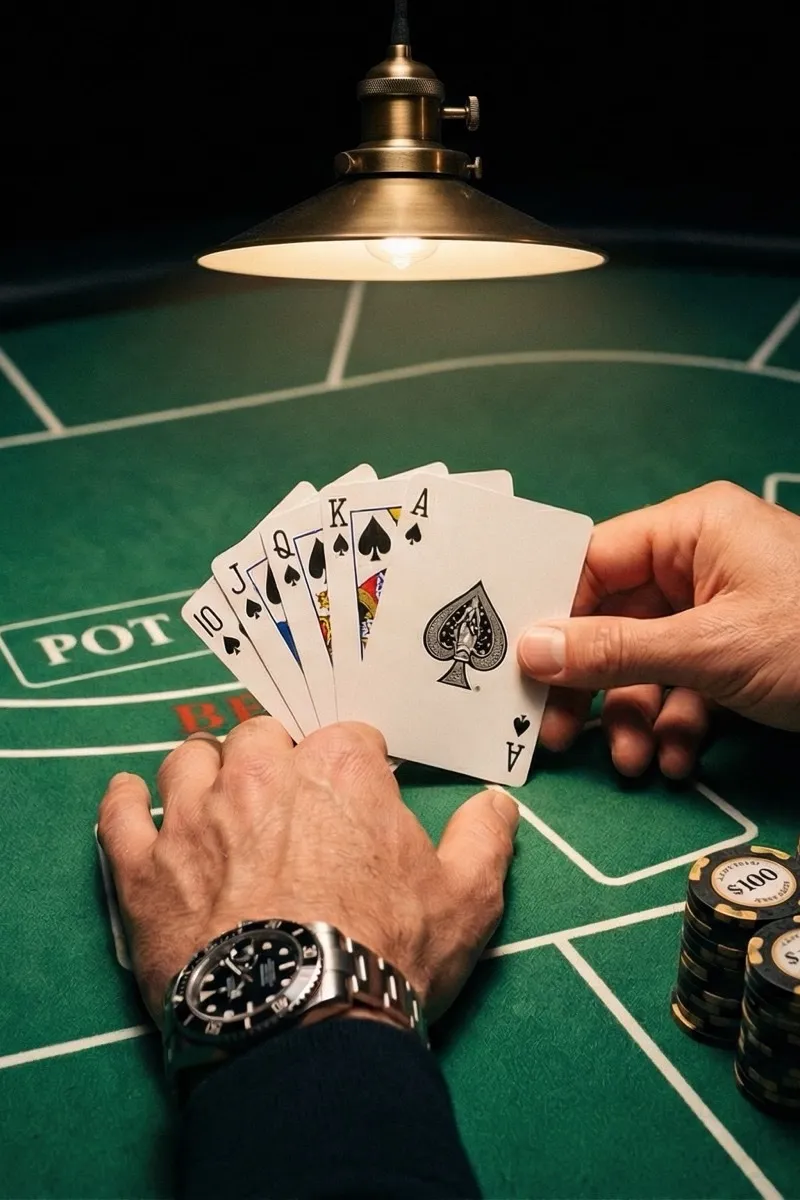
How position changes the value of your hands
A hand like 7-8 suited, which in early position is marginal at best, becomes a playable hand from the button against a middle-position opener. The reason isn’t that the cards have changed — it’s that the context in which you’ll play them is completely different.
With position, suited connectors and small pairs gain value because you can control pot size. If you miss the flop, you can check behind and see a free card. If you connect strongly, you can build the pot at the moments your hand justifies it. If you have a draw, you can evaluate whether it’s worth continuing with more information about your opponent’s strength.
Without position, those same hands lose value because every street involves a blind decision. You don’t know whether checking will invite a bet you can’t call, or whether betting will result in a raise that leaves you in an uncomfortable spot. Speculative hands need position to extract their potential value; without it, they’re traps.
Playing out of position: when and how to minimize the damage
Nobody chooses to be in the small blind, but everyone is there one in every nine hands. The question isn’t how to avoid weak positions — it’s how to reduce the damage when you’re stuck in them.
The first tool is simplifying your range. Out of position, the hands you continue with should be those that connect clearly with the flop and don’t require much navigation on difficult streets. Top pair with a strong kicker, sets, and flush draws with good equity are more manageable than two-tone connectors on a three-suited board.
The second tool is the selective donk bet: leading out on the flop instead of checking to the pre-flop aggressor. It’s a play many recreational players make without thinking, but in the hands of someone with sound judgment it can be effective on boards that connect better with your range than your opponent’s. It’s not a universal solution, but it’s part of the arsenal for anyone playing out of position with intention.
The third — and perhaps most important — is recognizing when it simply isn’t worth continuing. Defending the big blind with any two cards because “you’ve already put in half” is a classic mistake. Every hand you play out of position carries a structural cost that doesn’t disappear just because you’ve already invested chips in the pot.
Position and aggression: the button as a pressure tool
One of the most effective uses of late position is the ability to apply pressure with hands that aren’t necessarily the strongest in your range. When you open from the button and the flop connects with nobody, you hold the narrative advantage: you represent a stronger range and have the last word on every street.
The c-bet (continuation bet) in position is one of the most profitable plays in modern poker, precisely because it combines the initiative of having opened the hand with the advantage of acting last. Your opponent has to make a decision before knowing what you’ll do, which creates pressure even when your cards don’t justify the bet on their own.
This doesn’t mean betting blindly on every flop from the button. Boards that connect better with the big blind defender’s range are boards where the automatic c-bet loses value. Position amplifies well-calibrated aggression; it doesn’t replace critical thinking about the board texture and your opponent’s range.
Position in tournaments: when blinds rise, position becomes critical
In a tournament, position dynamics carry an additional layer of complexity: blinds increase, stacks shrink in terms of big blinds, and decisions become more binary. In the middle and late stages of a tournament, position can be the difference between surviving a round and being eliminated.
When your stack drops to between fifteen and twenty big blinds, position largely determines when and how you can shove effectively. An all-in from the button with a medium hand can be a solid play; the same shove from UTG with the same stack can be a mistake because the range of hands that can call you is much wider and more dangerous.
In the Tournaments at The Lounge, where blind levels advance on a fixed structure, understanding how the value of position shifts with your relative stack size is a skill that makes a real difference in the decisive stages. You can check the schedule and available formats directly in the tournaments section of the site.
How to develop positional awareness in every session
Theory is useful, but position is internalized through attentive play. There are a few concrete habits that accelerate that process.
The first is always knowing, before you look at your cards, what position you’re in relative to the button. That sounds basic, but many players look at their cards first and decide whether to play before considering their position. Reversing that order — evaluating position before cards — changes the frame from which you make the decision.
The second is keeping a mental record of how many hands you play out of position versus in position, and what the results look like. You don’t need analysis software to notice patterns: if you consistently lose chips in hands played from the blinds and recover them from the button and cutoff, that’s telling you something about your game worth paying attention to.
The third is reviewing the General Rules of the room where you play to understand the specific rules that apply — including aspects like Must Move at waiting tables, which can affect positional dynamics when you’re moved mid-session. And if you play in the Poker Room at The Lounge on Calle 81 #12-70, it’s also worth knowing the current Bad Beat Jackpot rules, which have their own eligibility requirements you’ll want to understand before the situation comes up at the table.
Position is one of those concepts that, once you truly understand it, you can’t stop seeing. Every hand you play has a positional dimension that was always there, even before you started paying attention to it. Developing that awareness doesn’t require years of study — it requires intention and the willingness to think one step before you look at your cards.
Related references
Frequently Asked Questions
- What does 'being in position' mean in a poker hand?
- Being in position means acting after your opponent in the post-flop betting rounds. The button (dealer) is the strongest position because it always acts last, giving you information about everyone else's decisions before you make your own.
- How many positions are there at a Texas Hold'em table?
- At a nine-player table there are nine positions: Small Blind, Big Blind, UTG (Under the Gun), UTG+1, UTG+2, Lojack, Hijack, Cutoff, and Button. Early positions are the weakest; the Button is the strongest.
- Can I win with bad cards if I have good position?
- Position doesn't turn bad cards into good ones, but it does widen the range of hands you can play profitably. With position you can steal pots more often, control pot size, and make more informed decisions than an opponent who acts before you.
- Does position strategy apply the same way in tournaments and cash games?
- The principles are the same, but the context differs. In tournaments, stack pressure and rising blinds make position even more critical at certain stages. In cash games you can rebuy, and the decision of whether to play a hand out of position carries less immediate urgency — though the long-term cost is still very real.
- Where can I play poker in Bogotá and put these strategies into practice?
- The Poker Room at The Lounge, in Zona T (Calle 81 #12-70), is the largest poker room in Bogotá. You can check the current rules and available tables in the Poker Room section of the site.
El juego descontrolado genera adicción. Juegue con moderación. Solo mayores de 18 años. Línea de ayuda: 106 (Secretaría de Salud de Bogotá).