

Poker Room
Bad beat jackpot accumulating for weeks with no winner: what happens to that pot
There are weeks when the bad beat jackpot at a poker room climbs, climbs, and keeps climbing without anyone touching it. Players watch the number on the board, run mental calculations, and at some point someone asks out loud: “But what happens if nobody wins it?” It is a fair question, because the behavior of a pot that has been accumulating for weeks is not obvious to anyone who does not know the mechanics from the inside.
This article answers exactly that: what happens to the money when the bad beat jackpot has gone a long time without hitting, why extended periods without a winner are mathematically normal, how the pot is distributed when someone finally triggers it, and what you should have straight before sitting down at a cash game table with that pot on the horizon.
Why the pot can accumulate for weeks without anyone winning it
The short answer is probabilistic: the bad beat jackpot is designed to be hard to trigger. For it to hit, losing a strong hand is not enough. Two players must hold extraordinarily good hands at the same time, both hands must be played to the end, and the losing hand must meet a minimum quality threshold defined in the rules. That combination of conditions is infrequent by design.
Think of it this way: in a normal cash game session, most pots are decided before showdown. Someone bets, the others fold, and the pot changes hands without anyone showing cards. For the jackpot to be possible, the cards have to reach the river, both players must hold high-ranking hands, and the “good” hand must lose to a “better” one. That does not happen every session or every week. It might happen twice in one month or not at all for two months.
What does happen on every hand played at eligible tables is that a small fraction of the pot feeds the jackpot. That means the longer time passes without a winner, the more money has accumulated from hundreds or thousands of hands. The pot is not waiting — it is growing.
What happens to the money while no one claims it
The money accumulated in the bad beat jackpot does not disappear, is not redistributed arbitrarily, and does not revert to the house after a set period. It stays in the pot, protected by the room’s rules and overseen by Colombia’s competent regulatory authority, Coljuegos. That is an important distinction: the jackpot is not a discretionary promotion the room can cancel on a Tuesday morning. It is a regulated mechanism.
While the pot keeps growing, cash game players at eligible tables are — not necessarily aware of it — contributing to it with every pot they play. The accumulation is silent and constant. The board in the room reflects that growth in real time, and it is common for regular players to start paying closer attention as the number climbs.
This has an interesting secondary effect on table behavior: when the pot has been accumulating for weeks and the number is visible and significant, some players adjust their willingness to go to showdown. Not because the odds of triggering the jackpot change (they do not), but because the perception of a potential prize alters the psychology at the table. It is a well-known phenomenon in rooms with large jackpots, and it is worth keeping in mind if you plan to play in that context.
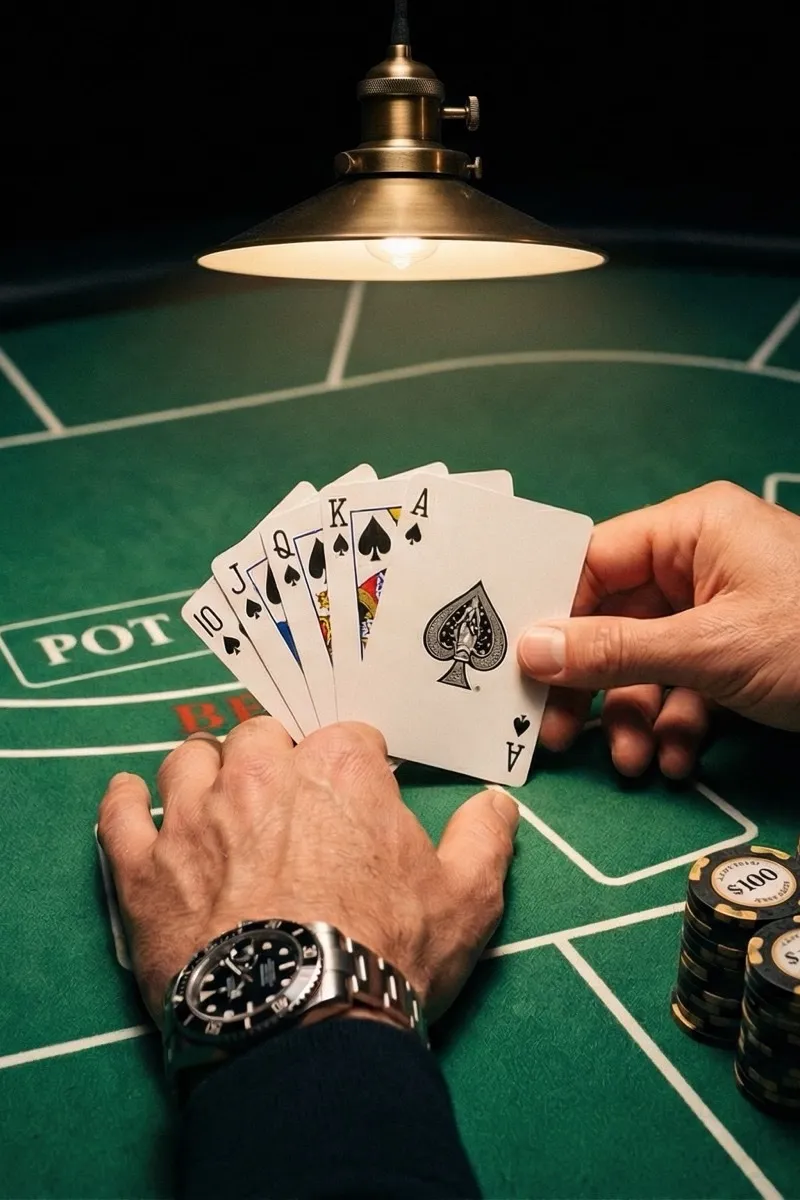
How the pot is distributed when it finally hits
When a valid bad beat jackpot is triggered, the pot does not go entirely to one person. The typical distribution splits the total among the bad beat loser (who receives the largest share), the winner of the hand, and in many rule sets, the other players seated at the same table at that moment. That last part surprises a lot of people: if you are seated at the table when the jackpot hits, even if you were not in that hand, you could receive a share.
The exact percentages of that distribution, and the conditions each participant must meet to qualify, are defined in the room’s current rules. Those details are not repeated here because they can change — the right move is to check them directly on the Bad Beat Jackpot page before you sit down. Knowing the distribution rules in advance is not just academic curiosity; it is information that can influence concrete decisions, such as which table to choose if several are running.
What is universal is the principle that the pot is distributed among real players — it does not go back to the house. After it hits, the pot resets to a predefined base amount, commonly called the “seed,” and begins growing again from that point. The cycle starts over.
The seed mechanic and why it matters after a jackpot
When the pot hits and is distributed, it does not go back to zero. It goes back to the seed — the guaranteed minimum amount with which each cycle begins. The reason is practical: a pot at absolute zero would take much longer to reach a level that justifies players’ attention, and the room wants the jackpot to be attractive from day one of the new cycle.
The seed is defined by the room’s rules and can vary. After a large jackpot, the new cycle starts with that guaranteed floor and begins growing again with contributions from every eligible pot. For players who arrived late in the previous cycle and never got to participate when the pot was large, the start of a new cycle is in some ways a clean starting point.
Understanding the seed also helps calibrate expectations. If someone tells you “the jackpot hit yesterday and it’s really low right now,” that is technically true but incomplete: the pot is already growing again from the moment it reset, and the rate of growth depends on the volume of hands played at eligible tables. In an active room, the pot can rise noticeably within just a few days.
What to check before playing at a table with an accumulated jackpot
If you have been watching the number on the board climb for weeks and are thinking about sitting down specifically because of that, there are a few things worth having straight before putting chips on the table.
First, confirm that the table you are going to play at is eligible for the jackpot. Not every cash game table in a room necessarily participates in the same pot; there may be minimum bet conditions or game variant requirements. At The Lounge, the poker room in Zona T has active cash game tables, and the eligibility conditions are in the general rules and on the Bad Beat Jackpot page.
Second, understand the minimum hand required. There is a threshold: the losing hand must be of a certain quality for the bad beat to be valid. If you lose with a hand that does not meet that threshold, the jackpot does not trigger, no matter how unlucky you feel subjectively. That threshold is in the current rules and is the first piece of information you should know.
Third — and this matters from a responsible gaming perspective — the jackpot does not meaningfully change the expected value of any individual hand. The probability of triggering it in any specific session is low. Sitting down to play cash game with winning the jackpot as your primary goal is not a strategy; it is a distortion of expectations that can lead to longer sessions or higher stakes than your actual bankroll warrants.
Long periods without a winner: what they say about the health of the pot
When the bad beat jackpot goes weeks or months without hitting, some players start to wonder whether something is wrong, whether the pot is “stuck,” or whether the conditions are harder than usual. The honest answer is that long periods without a winner are statistically normal and do not indicate any problem with the mechanism.
The jackpot has no memory. Every hand that reaches showdown under the right conditions has the same probability of triggering it, regardless of how long the pot has gone without hitting. The fact that it has not hit in six weeks does not make it “more likely” this week — that would be the gambler’s fallacy applied to a mechanism that operates on independent probabilities.
What is true is that a pot accumulated over weeks is larger than a recent one, and that has real value for whoever wins it. But that value should not be confused with a higher probability of winning it. Those are two different things. Players who understand that distinction make better decisions about how much time and money they dedicate to cash game sessions at tables with a jackpot.
If you have questions about the current state of the pot, the conditions in effect, or any aspect of the rules, the casino’s contact and reservations page is the direct channel to get answers before you reach the table.
Related references
Frequently Asked Questions
- Does the bad beat jackpot reset to zero when someone wins it?
- Not to absolute zero. The standard practice is for the pot to return to a predefined base amount called the "seed" and begin accumulating again. The exact details of the current seed are on the Bad Beat Jackpot page.
- Do I have to be in the hand to receive a share of the jackpot?
- It depends on the current rules. In many rooms, players seated at the table where the jackpot hits receive a portion even if they were not in the hand. Check the Bad Beat Jackpot rules to find out exactly who qualifies.
- What hand do I need to trigger the bad beat?
- The minimum hand required to trigger the jackpot varies according to the room's current rules. Review the Bad Beat Jackpot page before you play to know the current threshold.
- Does the jackpot apply in poker tournaments?
- The bad beat jackpot generally applies to cash game tables, not tournaments, because tournament chip structures are not compatible with the accumulation mechanism. Check the room's general rules to confirm.
- Can I see how much the pot has accumulated right now?
- The accumulated amount is displayed in real time on the floor. For details on how it is calculated and distributed, see the Bad Beat Jackpot page on the site.
- What happens if the jackpot goes months without hitting and the pot is very large?
- The pot keeps growing until a valid bad beat is triggered. There is no time limit or expiration date — the money stays in the pot until someone wins it. That is precisely what makes long periods without a winner so compelling for cash game players.
El juego descontrolado genera adicción. Juegue con moderación. Solo mayores de 18 años. Línea de ayuda: 106 (Secretaría de Salud de Bogotá).