

Table Games
Punto y Banca rules and card counting: how many cards are dealt and how points are tallied
Some casino games look complicated from the outside and turn out to be quite straightforward once you understand their internal logic. Punto y Banca is one of them. Most people who sit down at a table for the first time do so with questions about how many cards are dealt, when that third card appears, and — above all — how on earth the points are counted when the numbers seem to follow no familiar logic.
This article answers exactly that. We are not going to talk about advanced strategies or betting systems. The goal is more basic and more useful: so that when you arrive at a Punto y Banca table — whether at The Lounge in Zona T or at any licensed casino in Colombia — you understand what is happening with the cards without having to ask the croupier every other round.
It is worth taking the time to understand the count because it is the heart of the game. Unlike blackjack, where the player makes active decisions about their cards, in Punto y Banca the outcome follows fixed rules. Knowing them does not give you a strategic edge in the classic sense, but it does let you follow the game clearly, bet with confidence, and enjoy the experience without confusion.
How a hand is structured: the initial deal
Each round of Punto y Banca begins with two cards being dealt to each of the two hands in play: Punto and Banca. That is all that happens in the first phase, regardless of how many players are seated around the table or how many bets are on the felt. The cards are not dealt to individual players but to those two fixed positions.
The croupier deals the cards in a specific order, generally alternating between Punto and Banca. At the end of the initial deal, each hand has exactly two cards, and from that point it is already possible to calculate the value of each one. In many cases, those two cards are enough to determine the winner. In others, the rules require that a third card be dealt to one of the hands, to both, or to neither.
What does not happen in Punto y Banca is the player deciding whether to draw a card. That is a fundamental difference from blackjack. Here, the process is automatic and follows a predefined rules table that the casino applies without exception. This makes the game more passive in terms of decisions, but also more transparent: there is no room for human error in the deal.
The counting system: why the 10 is worth zero
The point count in Punto y Banca follows its own logic, and it is worth understanding from the outset so you are not confused during play.
Cards from 2 through 9 are worth exactly their face value. So far, perfectly normal. The ace is worth 1 point. But the 10, J, Q, and K are worth zero. No points at all. That means a hand made up of a king and a 7, for example, is worth exactly 7 points — as if the king were not there.
The second counting rule is the one that most confuses new players: when the sum of the cards exceeds 9, only the units digit is kept. If you have a 7 and a 6, the sum is 13, but the hand is worth 3. If you have an 8 and a 9, the sum is 17, but the hand is worth 7. There is no going bust as in blackjack. Busting does not exist. The tens digit is simply dropped and you work with what remains.
This has an important consequence: the maximum value a hand can have in Punto y Banca is 9. There is no hand of 10, 11, or 12. Nine is the ceiling, and a hand that reaches that value from the two initial cards is called a “natural” and, under the applicable rules, may close the round without any further cards being dealt. The same applies to a natural 8. For the exact details on how naturals are handled at the table, see the Punto y Banca page.
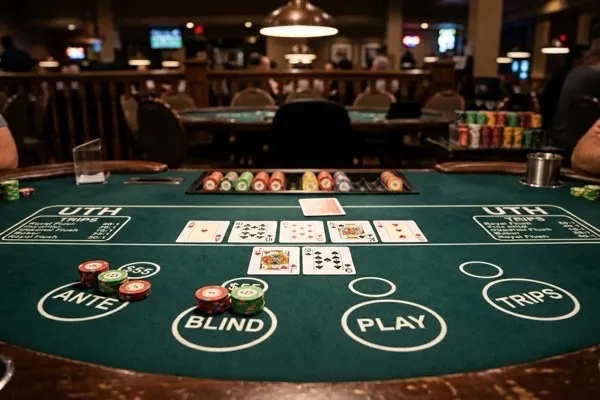
The third card: when it is dealt and why
The part that confuses new players most is the third card. It is not always dealt, and when it is, it follows different rules for Punto and for Banca. The most important thing to know is that neither of those decisions is made by the player: the croupier applies the casino’s rules table automatically.
For the Punto hand, the general logic is relatively straightforward: if the value of the two initial cards falls below a certain threshold, a third card is dealt; if it is above that threshold, Punto stays with two cards. The exact value of that threshold and the specific conditions are defined in the table rules.
For Banca, the process is more complex. Whether Banca receives a third card depends not only on the value of its own cards, but also on whether Punto received a third card and, if so, what that third card was. This creates a table of cross-referenced conditions that the croupier handles from memory, but which you as a player do not need to memorize — it is enough to know it exists and is applied consistently. If you want to study that table before sitting down, the current table rules are published on the Punto y Banca page.
Reading the table: how to follow the count in real time
Once you internalize the counting system, following a live round becomes quite natural. The croupier announces the values aloud after each deal, so you do not have to do the calculations on your own. But understanding the process lets you verify what you hear and follow the game with greater attention.
When the croupier turns over the cards, they add the values aloud. If the Punto hand shows a 4 and a 9, they will say “thirteen, three” or simply “three,” depending on the table’s convention. If a third card is then dealt — say, a 5 — the new total would be 8, and that would be Punto’s final value. Banca goes through the same process with its own cards.
The outcome of the round is simple: the hand with the higher value wins. If both hands have the same value, the result is a tie. Bets are paid according to the position you wagered on (Punto, Banca, or Tie), under the specific payout conditions published at the table when you sit down. There are no additional decisions to make once the cards are on the felt.
Punto y Banca versus other table games: key differences in the count
Understanding Punto y Banca is easier if you compare it with other games you probably already know. The most obvious difference is with blackjack: in blackjack, the goal is to get as close to 21 as possible without going over, and the player actively decides whether to hit or stand. In Punto y Banca, the goal is to reach 9, the player does not make that decision, and going bust does not exist because the counting system simply drops the tens digit.
Blackjack Loco, the local variant played in Colombia, shares the same active-decision mechanics as standard blackjack, though with its own rules worth reviewing before you play. In both cases, the player has agency over their cards, which creates a completely different dynamic from Punto y Banca.
Ultimate Texas Hold’em is another table game where the player does make decisions — in this case based on the strength of their poker hand against the dealer’s. The comparison helps illustrate that Punto y Banca occupies a particular place in the spectrum of casino games: it is a game where player skill does not influence the outcome of the cards, but where understanding the rules lets you bet with greater clarity and fewer surprises.
Bets, payouts, and what to keep in mind before you play
Betting in Punto y Banca is straightforward: you choose whether the winning hand will be Punto, Banca, or Tie, place your chips, and wait for the result. The exact payout conditions for each bet — including whether a commission applies to the Banca bet and how much side bets pay — are published on the Punto y Banca page and on the felt itself when you sit down.
What is useful to know in advance is that payouts are not the same for every position. Betting on Tie, for example, pays more than betting on Punto or Banca because it is the least frequent outcome. That does not necessarily make it the best bet: the frequency of each result is determined by the game’s probabilities, not by streaks or intuition.
The casino at The Lounge, located on Calle 81 at carrera 12 in Zona T, has a Punto y Banca table available for players who want to try the game in an environment regulated by Coljuegos. If you are new to the game, there is absolutely nothing wrong with asking the croupier to walk through the third-card process before the round begins — it is a common and entirely valid question.
If you play regularly, it is worth reviewing the conditions of the loyalty program. Details on how to accumulate benefits and the current thresholds are on the N1VEL Club page, and active promotions for casino tables are in the promotions section.
Related references
Frequently Asked Questions
- How many cards does each hand receive at the start of a Punto y Banca round?
- At the start of each round, both Punto and Banca receive two cards. Depending on the combined value of those two cards, the game rules determine whether a third card is dealt to one or both hands. The process follows a fixed rules table — it is not a decision made by the player.
- What value do face cards (J, Q, K) and the 10 have in Punto y Banca?
- Face cards and the 10 are worth zero points. This is one of the most important aspects of the count: a 10 adds nothing, and a hand of K+5, for example, is worth exactly 5 points.
- Can the player decide whether to draw a third card?
- No. In Punto y Banca the third card is drawn automatically according to a predefined rules table. The player does not make that decision — unlike blackjack, where the player actively chooses.
- What happens if the sum of the cards exceeds 9?
- When the total exceeds 9, only the units digit is kept. For example, 7+6=13, but the hand is worth 3. It is as if the tens digit is automatically dropped.
- Where can I find the exact rules for The Lounge's Punto y Banca table?
- The current rules — including third-card conditions, available side bets, and payouts — are published on the Punto y Banca page of the site.
- Is Punto y Banca the same game as Baccarat?
- Yes. Punto y Banca is the name by which Baccarat is known in Colombia and much of Latin America. The core mechanics are the same, although local variants may differ in commissions, payouts, and third-card rules.
El juego descontrolado genera adicción. Juegue con moderación. Solo mayores de 18 años. Línea de ayuda: 106 (Secretaría de Salud de Bogotá).