
Table Games
What Is Ultimate Texas Hold'em and How Does It Differ from Traditional Poker
If you’ve ever walked past a poker room and felt curious but held back by the thought of facing experienced players, Ultimate Texas Hold’em might be exactly what you’ve been looking for. And if you’re already a regular poker player, it’s worth understanding what makes this table game different — because it isn’t simply “easier poker.”
The question “what is Ultimate Texas Hold’em casino” has a concrete answer: it’s a table game in which you use the same winning hands as classic Texas Hold’em, but you play against the house instead of against other players. That changes almost everything else. The dynamics, the strategy, the pace, and the risk-reward relationship all work differently. This article breaks down those differences so you know what to expect before you sit down.
The fundamental difference: who you’re playing against
In traditional table poker — whether in a cash game or a tournament — your opponents are other people. The house has no cards in play; its income comes from the rake, a commission taken from each pot or charged by the hour per seat. Winning at poker means outplaying the other players, and that’s where reading opponents, managing position, bluffing, and pot-size control all come in.
In Ultimate Texas Hold’em, the dynamic is different. You receive two hole cards, the dealer also receives two, and both of you share five community cards — just like in classic Hold’em. But you’re not competing against anyone else at the table: your goal is for your best five-card hand to beat the dealer’s. Bluffing is impossible because the dealer makes no strategic decisions. The tension comes from somewhere else: from when and how much to bet within the game’s structure.
How the betting structure works
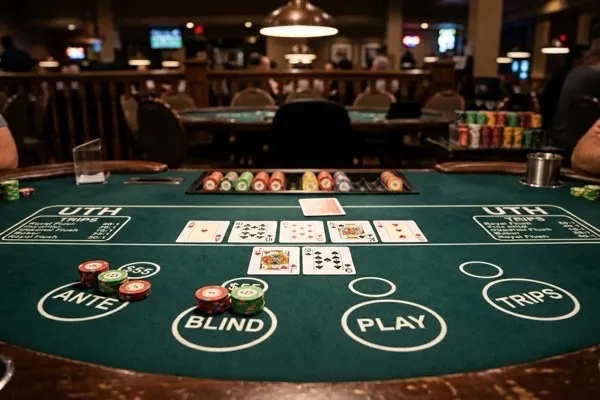
This is the part that confuses players coming from traditional poker the most. In Ultimate Texas Hold’em, before seeing any cards you must place two equal mandatory bets: Ante and Blind. From there, the game gives you three moments to bet or check:
- Preflop: you can make a Play bet of 3x or 4x the Ante value, or check.
- Flop: if you checked preflop, you can bet 2x the Ante, or check again.
- Turn/River: if you checked at both previous points, you can bet 1x the Ante or fold. If you fold, you lose both Ante and Blind.
The Play bet carries no house edge on its own — it’s simply the mechanism by which you scale your exposure according to the strength of your hand. Optimal strategy revolves around knowing when to bet 4x preflop and when it’s better to wait. The exact multipliers and the threshold for the dealer to qualify are published on the Ultimate Texas Hold’em page, as they can vary depending on the table version.
The Blind bet and why it matters
One of the most interesting features of the game is the Blind bet. Unlike the Ante, which pays 1:1 when you win, the Blind only pays out if you finish with a straight or better. With weaker hands, the Blind simply pushes — no gain, no loss.
This means you can win the Ante and the Play bet with a pair of aces, for example, but the Blind pays you nothing extra. For the Blind to pay off, you need to reach the end with a strong hand. That mechanic changes how you value your cards at each point in the game.
In addition, almost all versions of the game include a side bet called Trips, which pays out regardless of whether the dealer qualifies or whether you win the main hand. Trips pays if you have three of a kind or better among your cards and the community cards. The exact Trips pay tables are posted at the table when you sit down, and you can also check them on the Ultimate Texas Hold’em page.
When each game makes sense
Choose Ultimate Texas Hold’em if:
- You want to play at your own pace without depending on how many players are at the table.
- You’re interested in applying mathematical strategy without having to read opponents.
- You prefer knowing exactly what you’re up against (the dealer’s rules are fixed).
- You’re exploring the casino table games before committing to a poker table.
Choose traditional poker if:
- You enjoy interacting with other players and the psychological element of the game.
- You have enough experience to compete in an environment where everyone else is also trying to win.
- You’re interested in tournament formats or cash games with variable blind structures.
- You want to be eligible for jackpots exclusive to the poker room, such as the Bad Beat, whose conditions are detailed on the Bad Beat rules page.
Neither is objectively better. They’re different games that meet different needs. Many players at The Lounge, the casino in Zona T (Calle 81), alternate between both depending on their mood or how much time they have available that evening.
What both games share
Even though the mechanics are different, Ultimate Texas Hold’em and traditional poker share the same hand rankings. A full house beats a flush, a straight beats three of a kind, and so on. If you already know how to read poker hands, that part of the learning curve is already behind you.
Both games also reward players who take the time to understand strategy. In Ultimate Texas Hold’em, playing without a strategy means losing more than necessary over the long run. In traditional poker, the gap between an informed player and one who improvises is even more pronounced because opponents actively exploit mistakes.
How to get started
If you want to try Ultimate Texas Hold’em for the first time, the best starting point is to familiarize yourself with the hand rankings and the basic logic of when to bet preflop versus waiting for the flop. You don’t need to memorize a perfect strategy from day one, but understanding the general principle of “bet strong when you have a clear advantage, wait when you don’t” already puts you in a better position than someone betting at random.
For traditional poker, if you’re new to cash games, it’s worth reviewing the general poker room rules before sitting down — especially the details about Must Move, which are explained on the corresponding page. Knowing those rules in advance avoids surprises at the table.
If you’d like to explore other table games while you decide, Blackjack and Punto y Banca also offer distinct mechanics with their own learning curves. Blackjack Loco is a local variant worth getting to know separately. And if you’re already a regular player, check out the N1VEL Club benefits to see how your time at the table translates into concrete rewards.
Frequently Asked Questions
- Do I need to know how to play poker before sitting down at an Ultimate Texas Hold'em table?
- It helps to know the winning poker hands (royal flush, full house, pair, etc.), but you don't need any prior experience playing against other people. In Ultimate Texas Hold'em there's no bluffing, no reading opponents, and no positional play. The mechanics are closer to blackjack than to a cash game table.
- Can I practice the strategy before sitting down at the table?
- Yes. The optimal strategy for Ultimate Texas Hold'em is well documented and can be studied before you play. The starting point is learning when it's worth betting 4x preflop and when to wait for the flop or turn/river. Check the Ultimate Texas Hold'em page for the exact rules of the version played at the table.
- Does the Bad Beat Jackpot apply to Ultimate Texas Hold'em as well?
- No. The Bad Beat Jackpot is exclusive to live poker tables (cash games) where players compete against each other. In Ultimate Texas Hold'em you play against the house, so that jackpot does not apply. Check the Bad Beat rules at /en/poker/rules/bad-beat to understand the requirements for the poker tables.
- Which of the two games has a higher house edge?
- That depends on the specific variant and how well you apply the strategy. In Ultimate Texas Hold'em, the house edge on the Ante bet is low when the player uses optimal strategy, but side bets typically carry a higher edge. In traditional poker, the house takes rake rather than a direct mathematical edge. The exact conditions for each table are posted at the table when you sit down.
El juego descontrolado genera adicción. Juegue con moderación. Solo mayores de 18 años. Línea de ayuda: 106 (Secretaría de Salud de Bogotá).