
Table Games
Trips Bet in Ultimate Texas Hold'em: how it works and what you should know before playing it
If you already know Ultimate Texas Hold’em, you know the game has several layers: the Ante bet, the Blind, the Play, and that side bet sitting in the corner of the table that many players ignore or place without fully understanding how it works. That is the Trips bet, and it deserves attention of its own.
The reason it is worth understanding properly is straightforward: Trips behaves differently from everything else at the table. It does not depend on you winning the hand. It does not depend on the dealer qualifying. It has its own logic, its own pay table, and its own risk profile. Playing it without being clear on that is leaving money on the table — in the worst sense of the phrase.
This article explains how the Trips bet works in Ultimate Texas Hold’em, what makes it different from the other bets in the game, and what you should consider before including it in your table strategy.
What the Trips bet is and why it exists
Ultimate Texas Hold’em is a casino game based on the mechanics of traditional Texas Hold’em, adapted so that a player competes against the dealer rather than against other players. The betting structure includes Ante, Blind, and Play — the three bets that determine whether you win or lose the main hand. Trips is something different: it is an optional side bet that you place before the hand begins and that is settled in a completely independent way.
The idea behind Trips is simple. The casino offers you the chance to bet that your final hand — made up of your two cards and the five community cards — will be strong enough to trigger a payout. It does not matter what the dealer holds. It does not matter whether the main hand is won or lost. The only thing that counts is the category of your five-card hand.
This makes it a bet with a different mathematical profile from the main game. While in the main hand there are strategic decisions that affect the outcome — when to make the Play bet and for how much, for example — in Trips there is no decision at all once the chip is placed. The bet is made, the cards fall, and the pay table determines whether you collect or not.
How the Trips bet is settled, step by step
Once you place the Trips bet at the start of the hand, the game proceeds normally. You receive your two cards, the dealer receives theirs, and the five community cards are revealed in two stages: the flop (three cards) and the turn and river together (two more cards). With those seven cards available, you and the dealer each form the best possible five-card hand.
When all the cards are on the table, the dealer evaluates the main hand first, determines whether they qualified, and pays or collects the Ante, Blind, and Play bets accordingly. Then, separately, the dealer evaluates your five-card hand for Trips purposes. If your hand reaches the minimum threshold set by the pay table, you collect. If not, you lose the Trips bet regardless of what happened with the rest of the hand.
The critical point that many players do not immediately internalize is this: you can lose the main hand and collect on Trips at the same time. You can also win the main hand and lose Trips. They are two independent events that share the same set of cards but have separate outcomes.
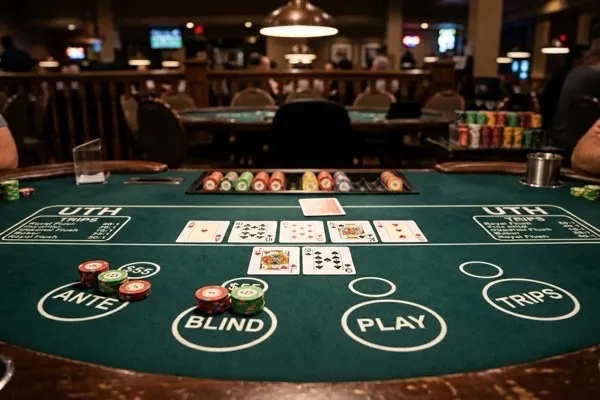
The pay table: where the key lies
The Trips pay table is what determines how much you collect based on the category of your hand. In general terms, stronger hands pay more, and there is a minimum hand below which there is no payout. That is where the name comes from: in many versions of the game, the minimum threshold is three of a kind — “trips” in poker parlance.
However, the exact pay tables vary. They vary between different versions of the game, between casinos, and can even vary between tables within the same establishment. This is not a minor detail: the difference between one pay table and another can significantly change the house edge on this side bet. A table that pays better on the highest hands may be more favorable than one that concentrates payouts on mid-range hands, depending on how frequently each hand appears.
For that reason, before placing chips on Trips, the first thing you should do is review the pay table posted at the table where you are going to play. At The Lounge, the current rules and tables are available on the Ultimate Texas Hold’em page. Reading them takes a minute and gives you concrete information about what you are betting on.
Trips versus the other bets in the game
To properly understand where Trips fits in the overall strategy, it is worth comparing it with the other bets in the game. Ante and Blind are mandatory to participate: without them, there is no hand. Play is the bet you make during the hand, after seeing your cards, and it is where strategy carries the most weight because you decide when to bet and for how much.
Trips, by contrast, is optional and decided before seeing any cards. This puts it in a different category: it is a bet of pure probability, with no subsequent strategic component. Once you place the chip, there is no decision you can make that will change the outcome. The cards fall as they fall.
This does not mean Trips is necessarily a bad bet or a good bet. It means it has a different risk profile. Side bets in general tend to carry a different house edge from the base game, and that difference can go in either direction depending on the specific pay table. What is true is that Trips adds volatility to your session: when a strong hand lands, the payout can be notably higher than anything you would get from the main hand; when it does not land, you lose the side bet on top of whatever happened with the rest.
Frequency of strong hands: what probability tells us
A useful way to think about Trips is through the frequency with which the hands that activate it appear. In a seven-card game where you choose the best five-card hand, strong hands are more frequent than in a five-card game, but they are still events that occur with a relatively low frequency in the context of a normal session.
Three of a kind — which in many versions is the minimum hand that triggers a payout — appears with a manageable frequency over a long session. Higher hands, such as straights, flushes, full houses, four of a kind, or straight flushes, are progressively rarer. The pay table reflects that rarity: the harder hands to make pay more precisely because they occur less often.
What this implies in practical terms is that Trips is a bet that can go many hands without activating, and then activate several times in a short period. That variance is part of its nature. A player who places Trips on every hand during a long session will see stretches of sustained losses on that side bet, interrupted by payouts that can be significant. Managing your bankroll with that in mind is part of playing with good judgment.
How Trips fits into a real gaming session
Thinking about Trips in isolation has its limits. In practice, the side bet is part of a session that includes the main hand, Play decisions, and overall bankroll management. That means there is not much point evaluating Trips without considering how it affects the total amount at stake per hand.
When you add Trips to every hand, you are increasing your exposure per hand played. In sessions where the cards do not cooperate, that translates into faster losses. In sessions where a strong hand lands, the Trips payout can offset losses on the main hand or amplify a positive session. The point is that the decision to play Trips should not be automatic or out of habit — it should be a conscious one.
Some players prefer to place Trips selectively, for example when a session is going well and they have room to take on more risk. Others prefer never to play it and focus on optimizing decisions in the main hand. Neither position is wrong; what matters is that the decision is yours and is based on understanding what you are betting on.
If you are in Bogotá and want to see how the game works before committing chips, one option is to watch a few hands at The Lounge’s Ultimate Texas Hold’em table in Zona T, where the pay table is visible at the table. Watching the game live, with the table in front of you, clarifies many things that a written description cannot fully convey.
Trips and the rest of the table game offering
Ultimate Texas Hold’em with its Trips bet is one of several table games that combine a main hand with side bets. If you are interested in exploring that kind of structure in other formats, it is worth getting to know Punto y Banca as well, which has its own betting logic and side bet variants, or reviewing the options for Blackjack and Blackjack Loco, where side bets also have their own pay tables that are worth reading before you play.
The logic that applies to Trips — understanding the pay table, knowing the approximate frequency of the hands that trigger the payout, and consciously deciding whether the added volatility fits your playing style — is the same logic that applies to any side bet in any table game. It is a habit worth developing.
If you want to review what is available at the casino before your next visit, or if you are interested in seeing whether there are active promotions that include table games, you can do so on the Promotions page. And if you visit regularly, the N1VEL Club has conditions that may be relevant to your visits; the current thresholds and benefits are published directly on that page.
Related references
Frequently Asked Questions
- Does the Trips bet depend on whether I win the main hand?
- No. Trips is settled solely based on the strength of your final five-card hand, regardless of whether the dealer qualified or whether you won the main bet. You can lose the hand and collect on Trips at the same time.
- Can I make only the Trips bet without playing the main hand?
- No. Trips is a side bet that is mandatory linked to participation in the hand. To place Trips, you must also place the Ante and Blind bets.
- Is the Trips payout the same at every table?
- Not necessarily. The pay table can vary between casinos and even between tables within the same casino. Check the pay table posted at the table before you sit down, or review the Ultimate Texas Hold'em page for the current details.
- Where can I find the full Ultimate Texas Hold'em rules at The Lounge?
- The current rules, including the Trips pay table, are published on the Ultimate Texas Hold'em page of the site.
- Does the Trips bet carry a higher house edge than the main hand?
- Side bets in general carry a different house edge from the main hand, and Trips is no exception. The exact figure depends on the pay table currently in effect at the table. The key point is that Trips is an independent bet with its own mathematics.
- What is the minimum hand I need to collect on Trips?
- The minimum paying hand varies according to the table's pay table. In most versions, three of a kind is the entry point — hence the name "Trips." Check the pay table posted at the table to confirm the exact threshold.
El juego descontrolado genera adicción. Juegue con moderación. Solo mayores de 18 años. Línea de ayuda: 106 (Secretaría de Salud de Bogotá).