
Blackjack
When to hit and when to stand in blackjack according to basic strategy
There is one question that comes up at almost every blackjack table, from the busiest casinos in Zona T to the quieter games on a Tuesday night: do I hit or stand? The instinctive answer is usually based on gut feeling, on what the previous player did, or on some superstition someone passed along years ago. The problem is that none of those sources account for the mathematics that govern the game.
Blackjack basic strategy is exactly that: a set of calculated decisions for every possible combination of your hand and the dealer’s upcard. It is not a magic system or a secret formula. It is the result of analyzing every possible combination and determining which action, on average, produces the best outcome over the long run. Learning it does not make you unbeatable, but it does take you out of the territory of arbitrary decisions.
This article explains how that logic works, when hitting in blackjack makes mathematical sense, and when standing is the right play even if instinct says otherwise. The exact rules at each table vary, so when you arrive at the casino, always verify the current conditions before you sit down.
Why the dealer’s card changes everything
Basic strategy does not simply tell you to “stand on 17 or more.” It tells you what to do based on your total and what the dealer is showing. That second variable is what turns an obvious decision into a calculated one.
When the dealer shows a low card — between 2 and 6 — they are in a vulnerable position. Table rules require the dealer to keep hitting until reaching a set minimum, and with a low upcard there is a considerable probability they will bust. In those scenarios, basic strategy frequently recommends standing on totals that might otherwise seem insufficient, because your best play is to let the dealer bust on their own.
When the dealer shows a high card — between 7 and Ace — the situation reverses. The dealer is more likely to reach a strong total, so you need to improve your hand to compete. This is where basic strategy pushes you to hit in situations that may feel uncomfortable, such as a 16 against a 10. Not because it feels good, but because statistically it is the option that loses the least over the long run.
Hard hands: the foundation of strategy
A hard hand is any hand without an Ace, or with an Ace that can only count as 1 without busting. These are the most common hands and the ones that generate the most uncertainty.
With totals of 8 or less, you always hit. There is no scenario where standing makes sense with such a low total. With 9, 10, or 11, basic strategy generally recommends doubling when the dealer shows a weak card, though the exact doubling conditions depend on the table rules. If doubling is not available or not advisable under the current rules, you hit.
The range between 12 and 16 is where most players make mistakes. With 12 against a dealer showing 2 or 3, basic strategy generally recommends hitting, because the probability of the dealer busting is not high enough to justify staying on such a weak total. With 12 against 4, 5, or 6, the recommendation changes: you stand, because the dealer is in danger territory. With 13 through 16 against low dealer cards, you also stand. With 13 through 16 against 7 or higher, you hit even if it hurts.
With 17 or more, basic strategy says to stand in virtually every hard-hand scenario. The risk of busting with another card outweighs the potential benefit of improving.
Soft hands: the Ace as a wildcard
A soft hand contains an Ace counted as 11 without the total exceeding 21. Ace + 6, for example, is a soft 17. It is called soft because if the next card would bust you, the Ace automatically reverts to 1.
That flexibility completely changes the calculation. With a soft hand you can hit in situations where you would stand with an equivalent hard hand, because the risk of busting is much lower.
Ace + 6 (soft 17) is the most illustrative example. With a hard 17, you always stand. With a soft 17, basic strategy frequently recommends hitting or doubling against weak dealer cards, because you have room to improve without the risk of busting. Ace + 7 (soft 18) is more complex: against low dealer cards it may be worth doubling, against mid-range cards you stand, and against a dealer’s 9, 10, or Ace, basic strategy recommends hitting. With Ace + 8 or Ace + 9, you always stand.
Pairs: when to split and when not to
When you receive two cards of the same value, you have the option to split the hand into two independent hands, each with its own bet. Basic strategy has clear rules about when it is worth doing so.
Pairs of Aces and pairs of 8s are split almost always, regardless of the dealer’s card. Two split Aces give you two chances to reach 21. Two 8s together form a 16, one of the worst possible hands; split, you have two hands with a reasonable starting point. Pairs of 10s are never split: a 20 is an excellent hand, and splitting it would waste a position of strength.
Pairs of 5s are also not split: two 5s form a 10, which is an ideal hand for doubling against many dealer cards. Pairs of 4s are generally not split. Pairs of 2s, 3s, and 7s are split against weak dealer cards and not against strong ones. Pairs of 6s follow similar logic. Pairs of 9s have their own logic: they are split against several dealer cards, but not against a 7, 10, or Ace, because an 18 already beats or ties many dealer totals with those cards.
How to practice basic strategy before you reach the table
Memorizing the complete basic strategy takes time. The good news is that you do not need it perfectly memorized from day one to benefit from it. There are practical ways to incorporate it gradually.
The most useful approach is to start with the extreme cases, which are the most frequent and the clearest: always hit with 8 or less, always stand with a hard 17 or more, never split 10s, always split Aces. Those rules alone eliminate several of the most costly mistakes. You can then work in the gray areas — the 12-to-16 range and soft hands — which are where basic strategy has the greatest impact.
There are apps and simulators that let you practice in training mode, where the program tells you whether your decision was correct according to basic strategy. Using them before sitting at a real table helps make decisions more automatic and less dependent on recalculating in the moment. At The Lounge on Calle 81, dealers are usually happy to answer questions between hands when the table is not busy, which can be a useful resource if you are learning.
What basic strategy cannot do for you
Basic strategy reduces the house edge to the lowest possible level within the rules of each variant. It does not eliminate it. Blackjack is still a game where the house has an edge, and that edge exists even when you play perfectly.
What basic strategy does do is remove you from the path of arbitrary decisions. When someone hits a 15 against a dealer’s 6 because they “have a feeling,” or stands on 14 against an Ace because they “have already lost enough,” they are making decisions that, on average, cost money. Basic strategy replaces those decisions with calculated options.
It is also worth understanding that basic strategy is a long-term guide. In a short session, you can follow it perfectly and still lose, or ignore it completely and win. That does not mean the strategy is wrong or that instinct is better. It means that chance operates in the short term, and mathematics only becomes clearly visible over many hands.
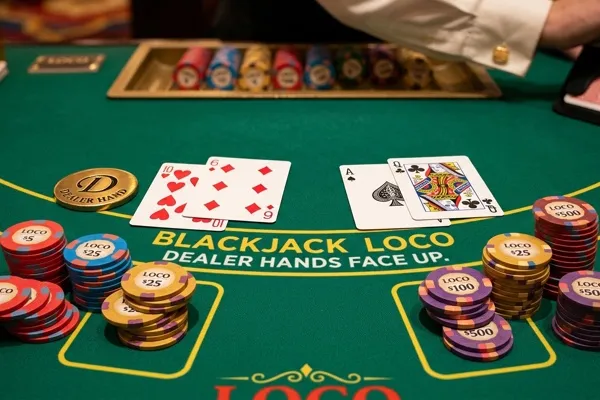
If you want to explore other casino tables with different dynamics, Punto y Banca and Ultimate Texas Hold’em offer experiences where player decisions carry a different weight. And if classic blackjack feels too familiar, the Blackjack Loco variant introduces its own elements that modify some of the optimal decisions, so it is worth reviewing its rules separately before applying standard strategy.
Related references
Frequently Asked Questions
- Does basic strategy guarantee I will win?
- No. Basic strategy reduces the house edge to the lowest possible level within each table's rules, but it does not eliminate the risk of losing. Blackjack is still a game of chance.
- Can I use a basic strategy card at the table?
- Many casinos allow it. The most practical approach is to ask the dealer before you sit down, since each venue has its own rules on the matter.
- Does basic strategy change depending on the number of decks?
- Yes, there are minor variations between single-deck, double-deck, and six- or eight-deck shoe games. The most relevant differences affect decisions with soft hands and certain pairs. Check the rules in effect at the table where you plan to play.
- What is a soft hand in blackjack?
- A soft hand is any hand containing an Ace counted as 11 without the total exceeding 21. For example, Ace + 6 is a soft 17. It is called "soft" because the Ace can be recounted as 1 if the next card would bust the hand.
- When is it better to double down instead of just hitting?
- Doubling down doubles your bet in exchange for receiving exactly one more card. Basic strategy recommends doubling in situations where your hand total and the dealer's upcard give you a statistical advantage. The exact doubling rules available at each table are listed on the casino's Blackjack page.
- Does Blackjack Loco use the same basic strategy rules?
- Blackjack Loco has its own variants that can change the optimal decisions. Check the Blackjack Loco page for its specific rules before applying standard strategy.
El juego descontrolado genera adicción. Juegue con moderación. Solo mayores de 18 años. Línea de ayuda: 106 (Secretaría de Salud de Bogotá).