
Blackjack
When to split pairs in blackjack: a practical guide with examples
Splitting a pair in blackjack is one of those decisions that separates players who rely on gut feeling from those who play with a clear rationale. The move looks simple: you have two matching cards and you can turn them into two independent hands. But behind that simplicity lies a mathematical logic that, once you understand it, completely changes the way you approach a table.
The problem is that many players split when they shouldn’t, or don’t split when they should. Both mistakes carry a real cost. This article explains when to split pairs in blackjack, why each decision works, and how to apply it at a real table — whether you’re playing for the first time at the casino or have spent years refining your strategy.
A word of warning before we begin: the exact rules at each table — including whether you can double after splitting, how many times you can re-split, or how aces are handled — vary. Everything you’ll read here is based on widely documented basic strategy principles, but you should always confirm the current conditions at the table where you plan to play. At The Lounge, for example, the updated rules for each variant are published on the game pages.
Why the dealer’s card changes everything
Before discussing specific pairs, there is one concept you need to have firmly in mind: in blackjack, the dealer’s visible card — the upcard — is the most important variable in almost any decision. This is especially true for splits.
When the dealer shows a low card, between 2 and 6, they are in a vulnerable position. Under the rules of most variants, the dealer must keep drawing until reaching a certain total, and with a low upcard there is a considerable probability they will bust. That means you don’t need to build a perfect hand; sometimes surviving is enough. In those scenarios, splitting mediocre pairs can make sense because you’re betting that the dealer will go over 21.
When the dealer shows a high card, between 7 and ace, the situation reverses. The dealer is more likely to complete a strong hand, and splitting to create two weak hands can cost you double. That’s why many splits that are recommended against a dealer showing 4, 5, or 6 stop making sense when the dealer shows a 9 or an ace. The dealer’s card is not a detail — it’s the axis around which the decision turns.
The splits you should almost never question
There are two pairs that basic strategy treats as near-universal splits: aces and eights.
Aces are the clearest case. A pair of aces totals 12 in its most useful form (or 2 in the hard version), a hand with little potential. But each ace on its own is the ideal start to a hand: any ten-value card gives you 21. Splitting aces turns an awkward hand into two opportunities. The only consideration that might nuance this is the table’s rules on how many cards you receive after splitting aces, since some tables limit you to one card per split ace. Check the conditions on the Blackjack page before assuming the rules are standard.
Eights are split for a different reason. A pair of eights totals 16, which is statistically the worst hand in blackjack: too high to hit comfortably, too low to stand with confidence. Splitting eights doesn’t guarantee a win, but it gets you out of that trap and gives you two hands starting from 8 — a far more manageable starting point. Even when the dealer shows a strong card, splitting eights remains preferable to sticking with 16.
The splits you should almost always avoid
At the other extreme are the pairs that almost never make sense to split: tens and fives.
A pair of tens (or any combination of ten-value cards: J, Q, K) gives you 20. That’s a winning hand in the vast majority of situations. Splitting it to create two hands starting at 10 is, in almost every scenario, a mistake. You’d be giving up a position of strength to bet double on two hands that need to improve just to match what you already had. The temptation to split tens when the dealer shows a 5 or 6 is understandable, but basic strategy is clear: stand with 20.
The pair of fives is different in its logic, but the conclusion is the same. Two fives total 10, which is an excellent starting point for doubling down. Splitting them creates two hands starting at 5 — a weak position. Instead of splitting a pair of fives, the correct play in most variants is to double down if the dealer shows between 2 and 9, or simply hit if the dealer shows a 10 or ace. Treating fives as a pair worth splitting is one of the most common mistakes among intermediate-level players.
Conditional splits: this is where the nuance lives
Between the clear-cut extremes are the pairs that require reading the situation. These are the splits that depend directly on the dealer’s upcard and, in some cases, on whether the table allows doubling after splitting.
Pair of twos and threes: These are weak hands that, when split, create two hands starting low. Splitting makes sense when the dealer is in a vulnerable position — typically showing between 2 and 7 — because you’re betting the dealer will bust. Against a dealer showing 8 or more, the usual play is to hit and try to build something better.
Pair of fours: This pair totals 8, a reasonable total to keep drawing on. Splitting is generally not recommended unless the table allows doubling after splitting and the dealer shows a very low card. Without that condition, hitting is usually the sounder option.
Pair of sixes: A pair of sixes totals 12, an awkward hand. Splitting against a dealer with a low card (between 2 and 6) makes sense because you create two hands that can improve while the dealer is at risk of busting. Against a strong dealer card, the split loses its justification.
Pair of sevens: Similar to sixes. Splitting is reasonable when the dealer shows between 2 and 7. Against an 8 or higher, keeping 14 and hitting is usually preferable to creating two hands starting at 7 against a dealer in a strong position.
Pair of nines: This is the most interesting conditional pair. Sixteen points is not a comfortable hand, but 18 is. Splitting nines against a dealer showing 2 through 6, and also against 8 or 9, has logic: you’re trying to improve each hand above 18. However, against a dealer showing 7, standing on 18 is generally better because the dealer likely has 17 and you already win. Against a 10 or ace, standing is also usually the right call.
How the number of decks and other rules affect splits
Basic strategy is not a fixed set of rules that applies identically everywhere. The number of decks in play, the dealer’s policy on soft 17, the availability of re-splitting, and the double-after-split option are all variables that adjust the calculations.
With a single deck, the composition of the shoe changes more quickly as cards come out, and that has small but real effects on some split decisions. With six or eight decks, those variations smooth out and standard basic strategy applies more uniformly. Most casinos in Bogotá, including The Lounge in Zona T, operate with multiple decks at their blackjack tables, but the exact conditions are on the game page.
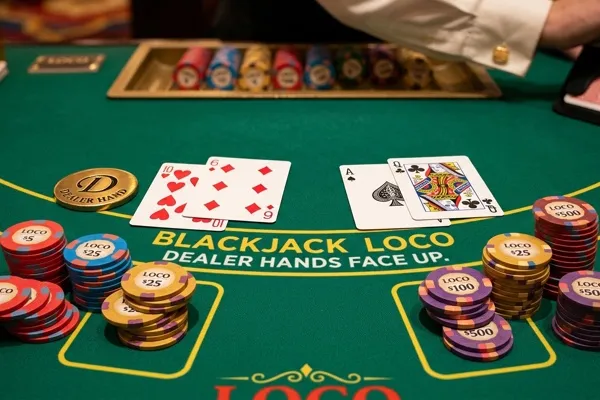
Re-splitting — the ability to split again if you receive another matching pair after the first split — also matters. If you can re-split aces, for example, you have more opportunities to make the most of each ace. If you can’t, that limits the expected value of the initial play. Likewise, if you’re playing Blackjack Loco, a variant with its own rules, split decisions may work differently. Don’t assume that what applies at one table applies at another.
How to practice splits before playing with real money
The best way to internalize these decisions is to practice them until they become automatic. There are free basic strategy simulators that let you play thousands of hands at no cost, and with each one you can check whether your decision was correct. The goal isn’t to memorize a list, but to understand the logic behind each play so you can adapt when a table’s rules are slightly different.
A useful tool is the basic strategy chart — a table that crosses your hand against the dealer’s upcard and tells you the optimal play. It’s not prohibited at most casinos, and using it while you’re learning is perfectly valid. Over time, the decisions become intuitive.
Once you feel comfortable with the logic, take that practice to a real table with minimum bets. The atmosphere of a live table — with the dealer’s pace and the decisions of other players — is different from a simulator. Practicing under real conditions, even with low stakes, accelerates learning in a way no simulator can fully replicate.
Related references
Frequently Asked Questions
- Should I always split aces in blackjack?
- In standard basic strategy, splitting aces is an almost universal play because each ace can head a strong hand. However, the exact rules on how many cards you receive after splitting aces vary by table. Check the Blackjack page for the current conditions.
- What happens if I get another pair after splitting?
- It depends on the table rules. Some allow you to re-split up to a set number of hands; others do not. Verify the conditions before you sit down so there are no surprises.
- Does splitting change the house edge?
- Yes. Splitting at the right moments reduces the house edge because you turn a weak hand into two hands with better potential. Splitting at the wrong moments does the opposite.
- Can I double down after splitting?
- At some tables yes, at others no. This option, known as double after split (DAS), significantly affects the optimal strategy for pairs such as 4-4 and 6-6. Check the current table rules before you play.
- Are the split rules the same in Blackjack Loco?
- Not necessarily. Blackjack Loco is a variant with its own conditions. Review the Blackjack Loco page to understand how splits work in that version.
El juego descontrolado genera adicción. Juegue con moderación. Solo mayores de 18 años. Línea de ayuda: 106 (Secretaría de Salud de Bogotá).